
- A Strategic Atlas Reading of Object Permanence, Physical State, and the Missing World Model
- The Cube as a Diagnostic Object
- The SKS Frame: Video Generation as State-Space Simulation
- The Visual Humanist: Beauty Without Engineering
- Why Math Can Work While Physics Fails
- The Hidden Axis: Surface Plausibility Versus State Fidelity
- Object Permanence as a Strategic Invariant
- The Strategic Invariants of Physical Video
- 1. Rigid-Body Integrity
- 2. Topological Consistency
- 3. Color Identity
- 4. Legal Transformation
- 5. Hidden-State Persistence
- 6. Trajectory Continuity
- Lawful Grounding: Why Prompting Is Not Enough
- The Rubik’s Cube as a World Model Test
- The Hands Problem Was Only the Beginning
- USC Reading: Seven Lenses on the Rubik’s Cube Failure
- Geometry
- Algebra
- Mechanics
- Topology
- Field Theory
- Information Theory
- Stochastic Theory
- From Video Generation to AI Safety
- The Strategic Trajectory: Toward Hybrid Video Systems
- Conclusion: The Cube Does Not Forgive Hallucination
- FAQ
- Why do AI video generators fail at Rubik’s Cube videos?
- Why is the Rubik’s Cube a good AI test?
- What is object permanence in AI video?
- What is the difference between surface plausibility and state fidelity?
- Why can AI solve math problems but fail at rotating a cube?
- What is a world model?
- Can better prompts fix the Rubik’s Cube problem?
- What does SKS add to this analysis?
- What is the hidden axis in this article?
- What are the main Strategic Invariants of physical video generation?
- Is this only a problem for video generation?
- What is the future of AI video generation?
A Strategic Atlas Reading of Object Permanence, Physical State, and the Missing World Model
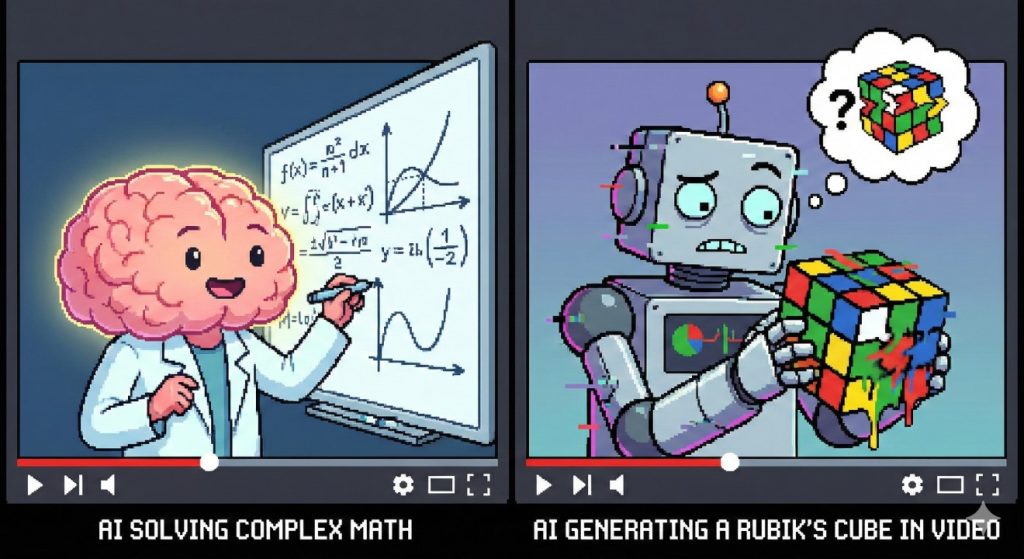
Ask a frontier AI system to solve a difficult mathematical problem, and it may surprise you with a proof that looks disciplined, elegant, and deeply structured.
Ask a video generation model to rotate a Rubik’s Cube, and the world begins to melt.
The cube bends.
The grid shifts.
The colors mutate.
A red square disappears behind an edge and returns as blue.
A perfect 3×3 face becomes 4×3, then 2×3, then something that only resembles a cube because the prompt insists that it is one.
The failure is strange because the object is simple.
A Rubik’s Cube is not a forest, a city, a crowd, a human face, or a storm at sea. It is a rigid plastic object with clear geometry, repeated structure, and strict mechanical constraints. It should be easy.
But for modern video generators, it is brutally diagnostic.
The Rubik’s Cube exposes a boundary that ordinary beautiful video hides: current generative models can often reproduce the appearance of physical reality without preserving the structure of physical reality.
They can render the surface.
They struggle to preserve the world.
The Cube as a Diagnostic Object
A Rubik’s Cube is a near-perfect test for video AI because it is visually simple but structurally unforgiving.
It has a rigid body.
It has faces.
It has cubies.
It has fixed colors.
It has rotational constraints.
It has a grid that must remain stable across perspective, motion, and time.
It has an internal mechanism that allows some transformations and forbids others.
A human child may not know group theory, but they quickly learn that the cube is not liquid. If one face turns, the whole object does not melt. If a red square rotates out of view, it does not cease to exist. If it returns, it should still be red unless a valid physical rotation changed its visible position.
That is the key.
The cube is not merely an image.
It is a stateful mechanical system.
A video model that treats it as a sequence of plausible images will eventually fail. Not because it lacks artistic skill, but because the cube demands something deeper than visual plausibility.
It demands physical state persistence.
The SKS Frame: Video Generation as State-Space Simulation
In Strategy Knowledge Science, a domain becomes strategically legible when it is represented as a structured state-space.
The Rubik’s Cube has exactly this structure.
Entities: cubies, stickers, faces, edges, corners, center pieces.
Coordinates: positions in the cube’s 3D configuration.
Regimes: solved, scrambled, rotating, occluded, partially visible.
Protocols: legal rotations.
Constraints: rigid geometry, color persistence, adjacency, mechanical continuity.
Trajectory: the ordered evolution of the cube across frames.
A valid video of a Rubik’s Cube is not just a series of images.
It is a trajectory through a constrained physical state-space.
Every frame must follow from the previous frame through lawful transition. Every hidden surface must persist when it leaves view. Every visible transformation must be compatible with the cube’s geometry.
This is where many video models fail.
They generate frames that look locally plausible but do not preserve the underlying state globally.
In SKS language, the model produces visual coherence without trajectory validity.
The Visual Humanist: Beauty Without Engineering
Current video generation models often behave like brilliant visual humanists.
They understand texture.
They understand lighting.
They understand cinematic motion.
They understand mood, style, softness, camera movement, reflections, depth cues, and visual rhythm.
But they often do not understand the engineering of the object.
To the human mind, a Rubik’s Cube has an inside. It has a mechanical architecture. Its visible faces are only the surface of a persistent object.
To a weakly grounded video model, the cube is often just a statistical pattern of colored squares.
When asked to rotate the cube, the model does not necessarily simulate a rigid-body transformation of a structured 3D object. It predicts what the next frame should look like based on visual patterns learned from data.
That difference is everything.
A physics-grounded model asks:
What object exists here, and what lawful transformation is happening to it?
A surface model asks:
What image would probably come next?
For many scenes, the second question is good enough.
For a Rubik’s Cube, it is not.
The cube punishes the absence of a world model.
Why Math Can Work While Physics Fails
To the general public, this feels paradoxical.
How can AI solve hard mathematical problems but fail to rotate a plastic toy?
The answer lies in the difference between symbolic reasoning and physical state evolution.
A mathematical proof can often be represented as a sequence of symbolic transformations. If the system has the right reasoning tools, search procedures, verification methods, or symbolic support, it can operate inside a formal space where truth is defined by rules.
Video generation is different.
A video model must preserve a world across time. It must remember what exists when it is not visible. It must maintain object identity, geometry, topology, lighting, occlusion, and lawful transformation frame after frame.
Mathematics asks:
Does this conclusion follow from these rules?
Physical video asks:
Does this world remain the same world as it changes?
That second problem is harder than it looks.
It requires not only pattern generation, but persistent physical representation.
The Hidden Axis: Surface Plausibility Versus State Fidelity
The visible question is:
Why can’t video AI rotate a Rubik’s Cube correctly?
The deeper question is:
Is the model preserving the physical state behind the image?
This reveals the hidden axis of the domain:
surface plausibility ↔ state fidelity
Surface plausibility means the image looks convincing moment by moment. The lighting works. The texture works. The motion looks smooth. The object resembles what the prompt requested.
State fidelity means the object remains structurally identical to itself across time. Hidden surfaces persist. Mechanical constraints are obeyed. Topology is preserved. Every frame is a lawful continuation of the previous state.
A video can score high on surface plausibility while failing state fidelity.
That is exactly what happens when a cube melts, changes colors, gains extra rows, loses edges, or violates its own geometry.
This hidden axis matters far beyond the Rubik’s Cube.
Any AI system that simulates the real world must eventually cross from surface plausibility to state fidelity.
Otherwise, it does not model reality.
It models the appearance of reality.
Object Permanence as a Strategic Invariant
The most obvious failure in generated Rubik’s Cube videos is color drift.
A red square disappears behind the cube. Seconds later, when the cube rotates back, the square is blue, yellow, missing, or replaced by a new pattern.
Humans recognize this as absurd because we possess object permanence. We understand that things continue to exist when they leave sight.
For video AI, object permanence is not guaranteed unless the architecture preserves hidden state.
In SKS terms, object permanence is a Strategic Invariant of physical video generation.
It is not optional.
It is not aesthetic.
It is not a style preference.
If an object leaves view and returns, its identity must persist unless a lawful transformation changed it.
This invariant governs every serious simulation domain:
a cube,
a car,
a surgical instrument,
a warehouse robot,
a drone,
a molecule,
a battlefield object,
a mechanical assembly.
If object permanence fails, the model is not simulating a world. It is improvising appearances.
The Strategic Invariants of Physical Video
Several invariants govern the Rubik’s Cube test and similar physical simulations.
1. Rigid-Body Integrity
The cube must remain a rigid object unless the scene explicitly includes damage, melting, cutting, or deformation.
If the cube bends like rubber or flows like liquid, the model has violated the physical regime.
2. Topological Consistency
The cube’s structure must preserve its 3×3 grid and cubie relationships. Rows cannot appear or vanish. Edges cannot detach arbitrarily. Faces cannot rewire themselves without a legal rotation.
3. Color Identity
A sticker’s color must persist across time and occlusion. It may move to a new visible position through rotation, but it cannot mutate without cause.
4. Legal Transformation
A Rubik’s Cube does not allow arbitrary motion. Its faces rotate around fixed axes. Every visible transformation must correspond to a mechanically possible move.
5. Hidden-State Persistence
The unseen parts of the cube must continue to exist when occluded. A serious world model must track not only what is visible, but what is temporarily hidden.
6. Trajectory Continuity
Each frame must be a lawful successor of the previous frame. A video is not a stack of beautiful images. It is a physical path through time.
These invariants are what the model must preserve to pass the test.
Lawful Grounding: Why Prompting Is Not Enough
A user can write:
“Generate a mathematically correct Rubik’s Cube rotation.”
“Preserve rigid-body physics.”
“Keep all colors consistent.”
“Use accurate 3D geometry.”
“Make the cube physically correct.”
But a prompt is not a physics engine.
If the model’s architecture does not contain or access a persistent 3D state representation, legal transformation rules, and physical constraints, the prompt can only encourage the surface. It cannot guarantee the structure.
This is the role of lawful grounding.
A video of a Rubik’s Cube must be grounded in the laws of the object:
3D geometry,
rigid-body motion,
cubie adjacency,
legal rotations,
occlusion persistence,
color identity,
and temporal continuity.
Without these constraints, the model can generate something that looks cube-like, but it cannot reliably generate the cube as a lawful system.
The failure is not merely visual.
It is ontological.
The model does not know what kind of thing the cube is.
The Rubik’s Cube as a World Model Test
The phrase “world model” is often used loosely. The Rubik’s Cube gives it a sharper meaning.
A world model is not just the ability to predict the next frame.
It is the ability to maintain a structured representation of what exists, how it can change, and what transformations are impossible.
A true world model would know:
the cube has stable parts;
some parts are hidden but still exist;
faces rotate in constrained ways;
colors remain attached to physical cubies;
a transformation must preserve topology;
future frames must follow from prior state.
This is why the Rubik’s Cube is such a powerful benchmark.
It is small enough to understand but strict enough to expose hallucination.
A model that cannot preserve a cube’s structure across a short video may still generate beautiful imagery. But it has not yet learned physical reality in the strong sense.
It has learned visual continuity, not lawful continuity.
The Hands Problem Was Only the Beginning
Early image models often failed at hands. They added extra fingers, fused joints, or produced anatomically impossible shapes.
The Rubik’s Cube is the hands problem in a more unforgiving form.
A hand is organic. It bends. It varies. It has soft boundaries. Some errors can hide inside style, motion blur, or biological variation.
A Rubik’s Cube is geometric.
It is defined by straight lines, fixed counts, rigid faces, and mechanical constraints. A wrong number of rows is not a stylistic variation. A color changing without cause is not expressive interpretation. A melting grid is not anatomical ambiguity.
The cube gives the model less room to hide.
That is why it matters.
It is not testing whether AI can draw a toy.
It is testing whether AI can preserve a lawful object through time.
USC Reading: Seven Lenses on the Rubik’s Cube Failure
A Strategic Atlas reading examines the failure through several scientific codes.
Geometry
The cube is a 3D coordinate structure. Its visible 2D projection must preserve the underlying 3D geometry. Failures appear when the grid warps, faces deform, or perspective breaks structural consistency.
Algebra
Every legal cube move is a transformation. The model must preserve the group-like structure of allowed rotations. Arbitrary pixel evolution is not valid transformation.
Mechanics
The cube is a rigid mechanical object. Its motion must obey constraints of rotation, attachment, and structural integrity.
Topology
The adjacency of cubies must remain stable. The cube cannot gain or lose rows, disconnect faces, or rewire its structure without violating the object’s topology.
Field Theory
The model operates under visual fields: lighting, occlusion, camera angle, motion blur, and perspective. These fields affect appearance, but they should not alter object identity.
Information Theory
The model must compress and carry hidden state across frames. If occluded information is lost, the regenerated object may become inconsistent.
Stochastic Theory
Small frame-level inconsistencies accumulate. A minor color drift or grid distortion can compound into full physical collapse across a video sequence.
Through this reading, the Rubik’s Cube failure becomes more than a visual artifact. It becomes a structural diagnosis of the model’s relation to reality.
From Video Generation to AI Safety
The Rubik’s Cube test is not only about video.
It is about whether AI systems can preserve lawful state over time.
This matters wherever AI is asked to simulate, plan, or act in physical or state-rigid environments:
robotics,
autonomous driving,
medical simulation,
military planning,
industrial control,
scientific visualization,
architecture,
manufacturing,
supply-chain simulation,
and embodied agents.
In these domains, surface plausibility can be dangerous.
A robot cannot rely on an object that changes identity when occluded.
A medical model cannot invent anatomy between frames.
A battlefield simulator cannot let vehicles disappear and reappear inconsistently.
An engineering system cannot treat rigid constraints as aesthetic suggestions.
A planning agent cannot act safely in a world whose state is only visually guessed.
The danger is not that the video looks strange.
The danger is that a model can produce a convincing surface while violating the laws that make the surface real.
That is the same deeper problem seen in LLMs playing chess: semantic or visual fluency without state fidelity.
The Strategic Trajectory: Toward Hybrid Video Systems
Pure text-to-video generation will not be enough for physically reliable simulation.
The likely future is hybrid architecture.
A serious system will combine:
a generative model for visual richness;
a 3D scene representation for object permanence;
a physics engine for lawful motion;
a state engine for persistent object identity;
a validator for impossible transformations;
and a renderer that turns grounded state into video.
This does not make generative video less impressive. It gives it the structure it needs.
The LLM or video model should not be the only keeper of reality.
In the future, the model may generate the style, camera movement, lighting, and cinematic surface. But the underlying world must be maintained elsewhere: in a grounded representation that knows what objects exist, where they are, how they move, and what they cannot do.
The transition is:
video as frame prediction → video as world simulation
That is the real frontier.
Conclusion: The Cube Does Not Forgive Hallucination
The Rubik’s Cube is humble, colorful, and small enough to fit in a child’s hand.
But as an AI test, it is severe.
It asks a simple question:
Can the model preserve a lawful object through time?
If the answer is no, then the cube melts.
The failure is not just a funny artifact. It reveals the gap between appearance and reality, between surface continuity and state continuity, between visual imagination and physical understanding.
The next generation of AI video will not be judged only by beauty.
It will be judged by whether the world remains the same world after the camera moves.
Until then, the Rubik’s Cube will remain one of the clearest tests of generative AI’s missing physics.
The machine can paint the cube.
But it has not yet fully learned how the cube exists.
FAQ
Why do AI video generators fail at Rubik’s Cube videos?
They often fail because they generate plausible-looking frames without preserving the cube’s underlying physical state. The result is color drift, warped grids, impossible rotations, melting faces, and inconsistent object identity.
Why is the Rubik’s Cube a good AI test?
A Rubik’s Cube is visually simple but structurally strict. It has fixed geometry, rigid-body constraints, persistent colors, legal rotations, and object permanence. These features make it a strong test of whether a video model understands physical state.
What is object permanence in AI video?
Object permanence means that an object continues to exist when it is temporarily hidden from view. In Rubik’s Cube videos, a colored square should remain the same square when it rotates out of sight and later returns.
What is the difference between surface plausibility and state fidelity?
Surface plausibility means the video looks convincing moment by moment. State fidelity means the underlying object remains consistent across time, occlusion, and motion. AI video models may achieve the first while failing the second.
Why can AI solve math problems but fail at rotating a cube?
Math problems can often be handled through symbolic reasoning and rule-based transformations. Video generation requires maintaining a persistent physical world across frames. That requires state, geometry, object identity, and lawful motion.
What is a world model?
A world model is an internal or external representation of what exists, how objects persist, how they can change, and what transformations are impossible. For video AI, a world model would help preserve physical consistency across time.
Can better prompts fix the Rubik’s Cube problem?
Prompts can help, but they cannot guarantee physical correctness if the model architecture lacks grounded state representation, physics constraints, or a 3D scene model. Prompting is not a substitute for a physics engine.
What does SKS add to this analysis?
Strategy Knowledge Science frames the Rubik’s Cube as a state-space problem. It identifies entities, coordinates, regimes, protocols, constraints, invariants, and trajectories, showing that the issue is not visual quality but invalid state evolution.
What is the hidden axis in this article?
The hidden axis is surface plausibility versus state fidelity. Video models can look convincing while failing to preserve the physical structure underneath the image.
What are the main Strategic Invariants of physical video generation?
The main invariants include object permanence, rigid-body integrity, topological consistency, color identity, legal transformation, hidden-state persistence, and trajectory continuity.
Is this only a problem for video generation?
No. The same issue appears wherever AI must preserve lawful state over time: robotics, simulation, autonomous systems, industrial control, medical visualization, logistics, and embodied agents.
What is the future of AI video generation?
The future is likely hybrid: generative video models combined with 3D scene representations, physics engines, state engines, validators, and renderers. This would move video generation from frame prediction toward world simulation.