
How Starting-Hand Strength, Position, Table Topology, and Mechanical Pricing Shape the First Strategic Trajectory
Preflop is the first moment in poker when the Navigator must transform incomplete information into a strategic trajectory.
Only two private cards are visible.
No community cards exist.
Most of the future state-space remains unresolved.
Yet the Navigator must already choose among:
Fold
Call
Raise
Re-raise
Commit
The beginner often reduces this decision to one coordinate:
How strong are my two cards?That coordinate matters.
But it is not preflop strategy.
A starting hand has measurable raw potential.
A preflop action has Expected Value inside a particular topology, response-space, and future betting structure.
Those are different objects.
The central distinction is:
Raw Starting-Hand Equity
≠
Strategic Value of the Preflop Action
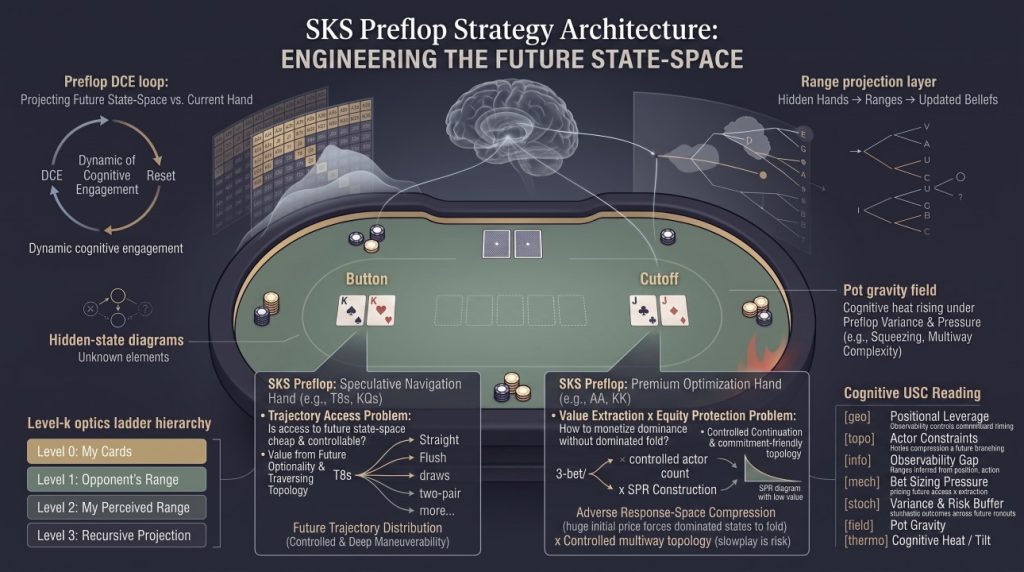
SKS therefore reads preflop as the first construction of a strategic state-space:
Starting Hand
×
Position
×
Players Yet to Act
×
Opponent Ranges
×
Stack Depth
×
Price
×
Action History
×
Future Information Order
→
Preflop Trajectory
But this article adds a second distinction.
A speculative hand such as:
T♠ 8♠and a premium hand such as:
A♠ A♦do not merely differ in raw strength.
They create different strategic optimization problems.
For T8s, the Navigator asks:
Is access to the future state-space cheap and controllable enough to justify entry?
For AA, the question becomes:
How can the Navigator monetize an already dominant coordinate without either forcing all dominated states out or allowing too many opponents cheap access to stochastic improvement?
This difference reveals the deeper physics of preflop strategy.
- 1. What Does Preflop Equity Actually Measure?
- 2. Top-50 Starting Hands: Six-Way Raw Showdown Equity
- Data Note
- 3. What the Table Actually Teaches
- 4. Premium Pairs Are Structurally Different
- 5. Why Suited and Connected Hands Matter Multiway
- 6. But Raw Equity Is Not a Preflop Chart
- 7. The First Preflop Projection Mismatch
- 8. The Topology of a Six-Max Table
- 9. UTG: Maximum Entry Resistance
- 10. Button: Same Cards, Different Topology
- 11. Position Is Control over Information Timing
- 12. Position Changes Range Width
- 13. The Active Strategic Invariant of Preflop Entry
- 14. Complete Hand I: T8s as Optionality Navigation
- 15. Flop: Optionality Becomes Structure
- 16. Turn: Future Optionality Expands
- 17. River: One Branch Realizes
- 18. SKS Meaning of the T8s Hand
- 19. Complete Hand II: AA as Controlled Value Extraction
- 20. AA Does Not Want Maximum Folds
- 21. Villain 3-Bets: New Information Arrives
- 22. What the 4-Bet Accomplished
- 23. Why the Same 4-Bet Logic Would Not Apply to T8s
- 24. Flop: AA Wants the Opponent to Hit Something — but Not Too Much
- 25. The Premium-Pair Paradox
- 26. Turn: Low SPR Converts Strength into Commitment
- 27. River: The Opponent Pays with a Worse Made Hand
- 28. Did AA Strategy Work Because Villain Had QQ?
- 29. Why Slowplaying AA Can Also Fail
- 30. The Correct Goal Is Controlled Continuation
- 31. Strategic Mechanics: Premium Hands Need Pricing, Not Panic
- 32. Why Normal Opening Sizes Also Protect Information
- 33. T8s versus AA: Two Opposite Preflop Problems
- 34. Optionality versus Domination
- 35. Future Branches Can Have Opposite Value
- 36. AA and KK Are Similar — but Not Identical
- 37. Starting-Hand Equity and Equity Realization Are Different
- 38. Position Still Matters with AA
- 39. The Blinds Remain Topologically Special
- 40. Preflop Is Response-Space Construction
- 41. The Range Begins Preflop
- 42. DCE: Two Different Projection Errors
- T8s Projection Movement
- AA Projection Movement
- 43. DSE: Why the Strategy Must Obey Poker
- Vector A — SKS → Poker
- Vector B — Poker → SKS
- 44. USC Reading
- 45. Strategic Hallucinations Prevented
- “This Hand Is Top 50, So I Should Play It”
- “AA Is Best, So Raise Huge”
- “If Everyone Folds, AA Worked Perfectly”
- “Slowplay Keeps More Customers, So It Is Better”
- “I Must Prevent Sets”
- “If Villain Hit a Set, My Preflop Strategy Was Wrong”
- “AA Wants Everyone to Call”
- “AA Wants Everyone to Fold”
- “Low SPR Is Always Good”
- “Position Matters Only for Weak Hands”
- 46. The Preflop Navigator Protocol
- 47. The Central Preflop Architecture
- Conclusion: Preflop Does Not Merely Select a Hand — It Engineers the Future
- See Also
- FAQ
- What is preflop equity?
- Is the Top-50 table an opening chart?
- Why can T8s be a profitable Button open despite modest raw equity?
- What is the main preflop objective with AA?
- Should AA simply raise as large as possible?
- Why not slowplay AA and keep everyone in?
- Does AA want exactly one opponent?
- Why can a normal opening size be preferable with AA?
- Why can a 4-bet be useful with AA?
- What does SPR add to premium-pair strategy?
- Is low SPR equally valuable for T8s?
- What is the fundamental difference between the two complete hands?
- Why is KK different from AA?
- If AA loses to a flopped set, was the preflop strategy wrong?
- What is the central SKS lesson?
1. What Does Preflop Equity Actually Measure?
Suppose six players receive random starting hands and all six are forced to reach showdown.
For a specified Hero hand, we can ask:
What percentage of complete runouts
does this hand win against
five random opponent hands?
That is raw six-way preflop showdown equity.
It describes a specific experiment:
6 players
+
5 random opponent hands
+
no folding
+
no future strategic action
+
automatic showdown
Real poker is different.
Players fold.
Players raise.
Ranges are selective.
Position changes observability.
Aggression changes actor count.
Sizing changes the cost of future access.
Some hands realize theoretical equity much more efficiently than others.
Therefore:
Raw equity describes the potential of the cards inside one fixed terminal experiment. Preflop strategy determines which future strategic state should actually be constructed.
2. Top-50 Starting Hands: Six-Way Raw Showdown Equity
The following is the supplied reference dataset for a six-player table.
The assumption is:
Hero holds the specified starting hand, five opponents hold random cards, and all six reach showdown.
Data Note
The supplied dataset contains duplicated hands with different quoted values—including KQs, 98s, JTs, QJs, T9s, and 76s—and is not strictly ordered by the displayed percentages.
It should therefore be treated as a pedagogical raw-equity dataset, not a normalized preflop strategy chart.
| Rank | Hand | Win Probability | Rank | Hand | Win Probability |
|---|---|---|---|---|---|
| 1 | AA | 49.2% | 26 | 98s | 23.3% |
| 2 | KK | 42.4% | 27 | ATs | 23.1% |
| 3 | 36.7% | 28 | JTs | 23.0% | |
| 4 | JJ | 31.9% | 29 | 76s | 22.8% |
| 5 | TT | 28.0% | 30 | KJs | 22.6% |
| 6 | 99 | 25.2% | 31 | QJs | 22.5% |
| 7 | 88 | 23.6% | 32 | A9s | 22.3% |
| 8 | 77 | 22.4% | 33 | KTs | 22.1% |
| 9 | AKs | 22.0% | 34 | QTs | 22.0% |
| 10 | 66 | 21.3% | 35 | A8s | 21.5% |
| 11 | 55 | 20.4% | 36 | J9s | 21.3% |
| 12 | 44 | 19.4% | 37 | T9s | 21.1% |
| 13 | 33 | 18.4% | 38 | A7s | 20.8% |
| 14 | 22 | 17.3% | 39 | K9s | 20.8% |
| 15 | AQs | 16.6% | 40 | Q9s | 20.7% |
| 16 | AJs | 16.5% | 41 | AKo | 20.5% |
| 17 | T9s | 16.2% | 42 | A5s | 20.3% |
| 18 | 98s | 16.1% | 43 | A4s | 20.1% |
| 19 | JTs | 16.1% | 44 | A3s | 19.9% |
| 20 | 87s | 15.9% | 45 | A2s | 19.7% |
| 21 | QJs | 15.8% | 46 | AQo | 19.3% |
| 22 | KQs | 15.7% | 47 | K8s | 19.1% |
| 23 | 76s | 15.5% | 48 | AJo | 18.7% |
| 24 | 65s | 15.3% | 49 | J8s | 18.5% |
| 25 | KQs | 23.5% | 50 | T8s | 18.2% |
Notation:
s = suited
o = offsuit
3. What the Table Actually Teaches
The most important lesson is not whether one neighboring hand has 21.3% or 22.0%.
It is that starting hands have very different structural access to future winning states.
Pocket pairs begin with made strength.
Suited hands acquire flush access.
Connected hands acquire straight access.
Premium pairs begin from an unusually dominant coordinate.
That last category deserves special attention.
4. Premium Pairs Are Structurally Different
AA does not primarily need to discover a future winning state.
It already begins ahead of every other individual starting hand.
Its strategic problem is therefore not:
How do I create enough future upside?but:
How do I extract value
from dominated continuing states
without giving too many opponents
cheap stochastic access
to states that can beat one pair?
That is a fundamentally different optimization problem from T8s.
For premium pairs:
Current Coordinate Strength ↑while the main dangers increasingly become:
Opponent Count ↑

Cheap Future Access ↑

Stack Depth ↑

Uncontrolled Multiway Topology ↑
5. Why Suited and Connected Hands Matter Multiway
Consider:
T♠ 9♠
9♠ 8♠
8♠ 7♠
7♠ 6♠
These hands begin without a made pair.
But they possess multiple future trajectories:
Straights
Flushes
Two Pair
Trips
Strong Draws
Combination Draws
Against many opponents, marginal one-pair terminal states become less robust.
The hand increasingly benefits from access to stronger terminal regions.
Conceptually:
Opponent Count ↑
→ Marginal Showdown Strength ↓
→ Value of Strong Future Structures ↑
This helps explain why connectivity and suitedness acquire additional structural importance in multiway states.
6. But Raw Equity Is Not a Preflop Chart
Suppose:
T8sshows:
18.2%in the supplied six-way showdown dataset.
That does not mean:
T8s should be played
whenever 18.2% seems sufficient.
Likewise:
AA = 49.2%does not mean:
Raise as much as possible immediately.Both conclusions commit the same Projection Mismatch:
Raw Hand Coordinate
→ Action
Real preflop poker is:
Starting Cards
→ Position
→ Price
→ Opponent Responses
→ Number of Players Remaining
→ Resulting Range
→ Future SPR
→ Information Order
→ Equity Realization
→ EV
The table describes card potential.
Strategy describes trajectory construction.
7. The First Preflop Projection Mismatch
A beginner learns:
AA = very strong
T8s = much weaker
72o = terrible
Necessary knowledge.
But insufficient strategy.
The same hand can rationally occupy different actions depending on:
Position
Opponent Action
Player Type
Stack Depth
Number of Actors
Price
Future Topology
Thus:
Hand Rank
≠
Preflop Strategy
And the same mistake occurs in opposite directions:
T8s is Top-50
→ therefore play
and:
AA is #1
→ therefore make the biggest possible raise
Both ignore the multidimensional state.
8. The Topology of a Six-Max Table
A six-max table is not six equivalent points arranged in a circle.
Each seat has a different action topology.
| Position | Players Yet to Act | Topological Character | Typical Strategic Effect |
|---|---|---|---|
| UTG | 5 | Maximum entry resistance | Narrowest opening structure |
| HJ | 4 | High resistance | Somewhat wider |
| CO | 3 | Increasing leverage | Larger steal/entry region |
| BTN | 2 | Maximum postflop positional leverage | Widest strategic entry space |
| SB | 1 | Low preflop resistance, poor postflop position | Aggressive but awkward |
| BB | 0 when action reaches it | Favorable immediate price, poor postflop position | Wide but topology-sensitive defense |
The cards remain fixed.
The possible response graph changes.
9. UTG: Maximum Entry Resistance
Suppose Hero is UTG with:
T♠ 8♠Five players remain.
Each one creates an additional response node:
Fold
Call
3-bet
Squeeze interaction
More importantly, the ranges that survive an UTG open tend to be selective.
So the relevant problem is not:
T8s
versus
five random hands
but:
T8s
versus
the strategic response distribution
of five remaining actors
Topological resistance is high.
10. Button: Same Cards, Different Topology
Now three players fold.
Hero has the same:
T♠ 8♠on the Button.
Only:
SB
BB
remain.
If both fold:
Hero wins immediately.If one calls, Hero usually acts later postflop.
The state becomes:
Only Two Players Behind
+
Immediate Fold Equity
+
Position
+
Suited Connectivity
+
Future Optionality
The cards did not improve.
The environment became easier to navigate.
11. Position Is Control over Information Timing
Position is not merely:
Acting later is good.Its deeper strategic value is:
Opponent Acts
→ Navigator Observes
→ Navigator Commits
versus:
Navigator Commits
→ Opponent Responds
Position therefore controls observability relative to commitment.
Conceptually:
More Information Before Commitment
→ Lower Projection Error
→ Better EV Calibration
This is an [info] × [geo] advantage.
12. Position Changes Range Width
As players fold:
5 Possible Response Nodes
→ 4
→ 3
→ 2
The state-space contracts.
This explains why opening ranges can widen toward the Button.
Not because:
T8s becomes stronger.But because:
fewer hostile response trajectories remain.This is topological compression before Hero acts.
13. The Active Strategic Invariant of Preflop Entry
The broad applied SI remains:
A preflop action is strategically valid when its projected value across the opponent response-space and future betting topology exceeds the cost of constructing that state.
Architecture:
Starting Hand
→ Position
→ Opponents Behind
→ Mechanical Price
→ Response Distribution
→ Resulting Range Geometry
→ Postflop Information Order
→ Equity Realization
→ EV(Action)
But the dominant dimensions differ by hand class.
That becomes visible in our two complete hands.
14. Complete Hand I: T8s as Optionality Navigation
Six-max.
Effective stacks:
100 BBHero is on the Button with:
T♠ 8♠UTG folds.
HJ folds.
CO folds.
Three adversarial nodes have already disappeared.
Hero opens:
2.5 BBSB folds.
BB calls.
Pot:
≈ 5.5 BBThe preflop action has:
reduced actor count;

preserved positional advantage;

created initiative;

filtered BB's Range;

created immediate fold equity;

purchased access to a future state-space
at relatively low cost.
This is a speculative-hand trajectory.
Hero is not buying a made hand.
Hero is buying optional access.
15. Flop: Optionality Becomes Structure
Flop:
9♣ 7♠ 2♦Hero:
T♠ 8♠Hero now has an open-ended straight draw.
BB checks.
Hero receives information first.
Hero bets:
1.8 BBBB calls.
Pot:
≈ 9.1 BBThe preflop topology has now produced postflop leverage:
Opponent Check
→ Information
→ Hero Action
16. Turn: Future Optionality Expands
Turn:
A♠Hero now holds:
Open-Ended Straight Draw
+
Flush Draw
BB checks.
Hero bets:
6 BBBB calls.
Pot:
≈ 21.1 BBThe speculative hand has entered a high-connectivity region.
The future branches that justified preflop entry have become strategically active.
17. River: One Branch Realizes
River:
6♥Hero completes:
6-7-8-9-Ta straight.
BB checks.
Hero value bets.
Suppose BB calls with:
Q♥ 9♥Hero wins.
But the river does not prove the Button open was correct.
That would be Result Fixation.
The preflop open was justified by:
Low Entry Resistance
+
Immediate Fold Equity
+
Position
+
Playable Structure
+
Future Optionality
+
Manageable Price
The river was only one stochastic branch.
18. SKS Meaning of the T8s Hand
The T8s hand is primarily about:
Access
Optionality
Position
Trajectory Diversity
Equity Realization
Its key question is:
Can a modest starting coordinate profitably enter a favorable topology?
The hand wants:
low-cost access;

manageable resistance;

postflop maneuverability;

multiple future branches.
This is why T8s often benefits from preserving a relatively wide future tree.
Its value is partly the value of what it may become.
19. Complete Hand II: AA as Controlled Value Extraction
Now reverse the strategic problem.
Six-max.
Effective stacks:
100 BBHero is in the Cutoff with:
A♠ A♦Action folds to Hero.
Hero opens:
2.5 BBWhy not:
10 BB
12 BB
15 BB
simply because Hero has the strongest starting hand?
Because a huge initial price can produce:
Weak / Medium Dominated Hands
→ Fold

Strong Continuing Region
→ Remains
Hero may mechanically remove exactly the states from which the premium pair wants to extract value.
This is adverse response-space compression.
20. AA Does Not Want Maximum Folds
With AA, Hero already possesses exceptional current coordinate strength.
The goal is therefore not:
Protect 100% of current equity.Nor:
Keep everyone in at any price.The goal is:
Preserve Dominated Continuation
+
Charge for Stochastic Access
+
Reduce Excessive Actor Count
+
Build a Favorable Pot / Stack Geometry
This creates the premium-pair optimization:
Value Extraction
×
Equity Protection
Neither axis can be maximized independently.
21. Villain 3-Bets: New Information Arrives
Hero opens 2.5 BB.
Button 3-bets to:
8.5 BBBlinds fold.
Now Villain has voluntarily revealed something important.
The continuing Range has become stronger and narrower.
Conceptually:
Wide Preflop Range
→ 3-Bet
→ Stronger Continuing Region
Hero can now apply more mechanical pressure without simply chasing all weak hands away.
Hero 4-bets:
22 BBButton calls.
Pot becomes approximately:
45.5 BBEffective stacks behind:
≈ 78 BBSPR is now roughly:
78 ÷ 45.5
≈ 1.7
This is a radically different topology from a single-raised multiway pot.
22. What the 4-Bet Accomplished
The preflop sequence:
Open
→ 3-Bet
→ 4-Bet
→ Call
has accomplished several things.
It has:
reduced the hand to one opponent;

preserved a strong dominated continuing Range;

built a large pot;

lowered future SPR;

compressed future maneuverability;

made overpair value easier to realize.
This is not simply:
AA is strong
→ put more money in.
It is:
Opponent Reveals Strong Continuation
→ Hero Increases Price
→ Future Topology Becomes Commitment-Friendly
The information and mechanics are coupled.
23. Why the Same 4-Bet Logic Would Not Apply to T8s
Suppose Hero held:
T♠ 8♠instead.
The same sequence:
2.5
→ 8.5
→ 22
would have a completely different meaning.
T8s derives much of its strategic value from:
cheap access;
deep maneuverability;
future optionality;
postflop position.
A large 4-bet can destroy those advantages:
Price ↑
SPR ↓
Range Strength Faced ↑
Future Maneuverability ↓
For AA, low SPR is often welcome.
For T8s, it may destroy the very topology that made entry attractive.
This is one of the central contrasts of the article.
24. Flop: AA Wants the Opponent to Hit Something — but Not Too Much
Flop:
J♣ 7♦ 3♠Hero:
A♠ A♦Villain’s 4-bet calling Range may contain hands such as:
QQ
KK
selected JJ
AK
selected other strong holdings
depending on the player and construction.
Hero does not want Villain to have folded everything preflop.
Hero wants dominated hands still present.
Hero bets small:
≈ 11.5 BBinto:
≈ 45.5 BBVillain calls.
Suppose Villain actually holds:
Q♠ Q♥This is close to an ideal value-extraction state.
Villain has enough hand strength to continue.
But Hero remains far ahead.
25. The Premium-Pair Paradox
This reveals an important paradox.
Hero does not maximize AA by preventing Villain from seeing every flop.
If Hero had forced QQ to fold preflop with an absurdly large raise:
Equity Protection
= excellent
but:
Value Extraction
= poor
Instead Hero wants Villain to enter a state such as:
Strong Enough to Continue
+
Weak Enough to Be Dominated
This is the premium-pair value region.
The best opponent state is often not:
Complete Missbut:
Second-Best Made Hand26. Turn: Low SPR Converts Strength into Commitment
Turn:
4♣Board:
J♣ 7♦ 3♠ 4♣Hero still has an overpair.
Because the pot was built preflop, the remaining tree is already compressed.
Conceptually:
High Preflop Investment
→ Low SPR
→ Fewer Future Mechanical Degrees of Freedom
→ Easier Value Commitment
Hero bets again.
Villain with QQ can continue.
The premium pair is realizing value not because AA magically prevents improvement, but because the preflop topology created a favorable relation between pot size, opponent Range, and remaining stack.
27. River: The Opponent Pays with a Worse Made Hand
River:
2♥Final board:
J♣ 7♦ 3♠ 4♣ 2♥Hero still holds the overpair.
Villain still has QQ.
The remaining stack can now be used for terminal value extraction depending on the exact Range and opponent response.
The important thing happened much earlier.
Preflop Hero constructed:
One Opponent
+
Strong but Dominated Range
+
Large Pot
+
Low SPR
The later streets simply monetized that architecture.
28. Did AA Strategy Work Because Villain Had QQ?
No.
That would again be Result Fixation.
Villain could have:
KK;
AK;
JJ;
other permitted 4-bet continuations.
Different boards could create different regimes.
The preflop strategy cannot be validated by one revealed hand.
The relevant question is:
Did Hero's action preserve enough worse continuation
while charging enough for access
and creating favorable future topology?
That is the preflop audit.
29. Why Slowplaying AA Can Also Fail
Now consider the opposite extreme.
Hero limps or uses a line that allows:
5 players
→ cheap flop access.
AA remains the strongest starting pair.
But each additional actor contributes another stochastic path capable of overtaking one pair.
Conceptually:
Opponent Count ↑
→ Joint Improvement Pathways ↑
→ AA Equity Realization ↓
One opponent may make:
setanother:
two pairanother:
straightanother:
flushThe problem is not specifically:
Someone might hit a set.The deeper problem is:
Too Many Actors
×
Cheap Future Access
→ Excessive Joint Stochastic Resistance
AA does not want the entire table to buy the future cheaply.
30. The Correct Goal Is Controlled Continuation
This produces the premium-pair principle:
The goal with AA is neither to force everyone out nor to preserve everyone. It is to make worse hands continue inside a price and topology favorable to AA.
The desirable architecture is often:
Premium Pair
→ Meaningful Price
→ Controlled Actor Count
→ Dominated Continuing Range
→ Favorable SPR
→ Value Extraction
Not:
Premium Pair
→ Maximum Raise
→ Everyone Folds
and not:
Premium Pair
→ Maximum Slowplay
→ Five-Way Flop
Both extremes can destroy value for opposite reasons.
31. Strategic Mechanics: Premium Hands Need Pricing, Not Panic
A preflop raise with AA/KK can simultaneously:
Extract from Worse Hands

Charge Speculative Hands

Compress Actor Count

Build the Pot

Change SPR

Generate Initiative

Filter Opponent Range
The optimization is not:
How big can I raise?It is:
Which size creates
the highest-value response distribution?
This is advanced [mech] Strategic Mechanics.
Bet size is not merely money added to the pot.
It changes which hidden states remain alive.
32. Why Normal Opening Sizes Also Protect Information
Suppose Hero opens:
2.5 BB with normal rangebut suddenly uses:
10 BB only with AA/KK.The sizing itself begins to reveal the hidden hand.
Conceptually:
Hero Size
→ Hero Strength
→ Opponent Projection Error ↓
Hero reduces their own Observability Gap.
Using similar opening mechanics across a wider Range can preserve:
Range Opacitywhile allowing later opponent responses to reveal useful information.
This is another reason premium value should often be extracted through the response tree, not through an obvious initial overreaction.
33. T8s versus AA: Two Opposite Preflop Problems
The two complete hands can now be compared directly.
| Dimension | T8s on Button | AA / Premium Pair |
|---|---|---|
| Initial structural value | Moderate | Extremely high |
| Primary source of value | Future optionality | Current domination |
| Main preflop question | Is access cheap and controllable? | How much dominated action can be preserved? |
| Preferred actor structure | Usually limited | Usually controlled, often heads-up |
| Desired future tree | Flexible | More commitment-friendly |
| Value of deep maneuverability | High | Lower relative importance |
| Value of low SPR | Often lower | Often high |
| Main risk | Paying too much for speculative access | Losing value or allowing too much cheap multiway access |
| Key topology | Position + optionality | Actor control + SPR compression |
| Mechanical goal | Buy future trajectories efficiently | Price continuation without eliminating dominated Range |
| Dominant SKS meaning | Trajectory Access | Value Extraction × Equity Protection |
The same concept—
Preflop Strategy—therefore means different things depending on the starting state.
34. Optionality versus Domination
This is the deepest contrast.
T8s says:
My current coordinate is not dominant.

I need favorable topology
to access future states
that can become dominant.
AA says:
My current coordinate is already dominant.

I need favorable mechanics
to monetize that domination
before stochastic branching
and excessive actor count erode it.
Thus:
T8s
→ Value from Future Optionality

AA
→ Value from Present Dominance
This distinction is more important than simply:
AA is stronger than T8s.35. Future Branches Can Have Opposite Value
For T8s:
More Useful Future Branches
→ Potential Strategic Value
Straights, flushes, two pair, draws, semi-bluffs.
For AA:
More Uncontrolled Opponents
+
More Cheap Future Branches
→ Potential Strategic Loss
AA does not need many stochastic rescue paths.
Its primary task is to prevent the rest of the table from obtaining too much cheap access to theirs.
This creates a powerful SKS symmetry:
Speculative Hand:
Future Branching = Resource

Premium Pair:
Uncontrolled Opponent Branching = Risk
36. AA and KK Are Similar — but Not Identical
KK belongs to the same premium-pair architecture.
But it has an additional regime-changing vulnerability:
Axx FlopBefore the flop:
KK
→ dominant premium pair
On:
A♣ 8♦ 3♠the state changes.
A substantial opponent Ax region can now dominate Hero.
So:
Starting-Hand Strength
≠
Permanent Strategic Strength
AA can also be overtaken by sets, straights, flushes, and two pair.
But KK has an especially visible single-card regime trigger:
Ace Arrives
→ Relative Range Geometry Changes
The preflop strategy may still have been correct.
The postflop state simply entered a new regime.
37. Starting-Hand Equity and Equity Realization Are Different
Two hands may have measurable raw equity yet realize it very differently.
A speculative hand may require:
position;
deep stacks;
future maneuverability;
appropriate price.
A premium pair may benefit from:
fewer opponents;
larger pot;
lower SPR;
strong dominated continuation.
Therefore:
Raw Equity
≠
Realized Strategic Value
The realization mechanism itself depends on hand architecture.
38. Position Still Matters with AA
Premium strength does not abolish topology.
AA in position still gains:
More Information Before Commitment
→ Better Sizing
→ Better Value Extraction
→ Better Pot Control on Dangerous Runouts
AA out of position can still face:
Earlier Commitment
→ Greater Response Uncertainty
The premium pair reduces some strategic difficulty.
It does not flatten the state-space into one dimension.
39. The Blinds Remain Topologically Special
The Small Blind combines:
Low Preflop Entry Resistance
+
Poor Postflop Information Order
The Big Blind combines:
Favorable Immediate Price
+
Wide Defensive Range
+
Postflop Positional Cost
This matters for both example classes.
A Button T8s open exploits blind topology.
An AA open from earlier position must anticipate how multiple downstream nodes can respond.
The card and seat remain coupled.
40. Preflop Is Response-Space Construction
Every raise changes what the other actors can rationally or behaviorally do.
Before an open:
Check / Free Accessmay exist for the blinds.
After the raise:
Fold
Call
3-Bet
becomes the response-space.
A larger raise may:
increase folds;
increase price;
narrow calls;
change 3-bet incentives;
build the pot.
A smaller raise may:
preserve more weak states;
risk less;
maintain wider responses.
With T8s, Hero may value cheap access.
With AA, Hero may value keeping dominated calls and raises alive while still charging them.
Same mechanics.
Different strategic objective.
41. The Range Begins Preflop
Every later Range Projection begins from:
R₀If the preflop prior is wrong:
Wrong R₀
→ Wrong Flop Range
→ Wrong Turn Range
→ Wrong River Range
→ Wrong EV
Preflop therefore establishes more than the first pot.
It establishes the initial probability distribution of hidden states used throughout the hand.
42. DCE: Two Different Projection Errors
T8s Projection Movement
Beginner:
T8s is in the Top 50.
Therefore play.
Verification asks:
Position?
Actors behind?
Price?
Future position?
3-bet risk?
Equity realization?
Reset:
Hand Rank
→ Position-Specific Entry State
AA Projection Movement
Beginner:
AA is the best hand.
Therefore raise as large as possible.
Verification asks:
Which worse hands continue?

Which hands disappear if I overprice?

How many opponents remain?

What speculative access am I giving?

What future SPR will result?

Can opponent aggression build the pot for me?
Reset:
Maximum Hand Strength
→ Controlled Value-Extraction State
The errors are opposite.
One overestimates a modest hand.
The other mismanages a dominant hand.
43. DSE: Why the Strategy Must Obey Poker
Vector A — SKS → Poker
SKS contributes:
Navigator
Position
Range
Topology
Response-Space
Price
Trajectory
Regime
Strategic Invariant
Vector B — Poker → SKS
Poker constrains the model through:
52-card deck;
blind structure;
betting order;
legal sizes;
stack depth;
card combinations;
position;
rake;
showdown rules;
actual opponent behavior.
For example:
AA benefits from low SPRcannot remain an abstract metaphor.
Its meaning arises from concrete:
Pot Size
÷
Remaining Effective Stack
and the resulting compression of future betting trajectories.
44. USC Reading
| USC Lens | Preflop Reading |
|---|---|
[geo] Strategic Geometry | Seat position determines action order and information leverage. |
[topo] Strategic Topology | Players behind create response nodes; action can compress actor count and future betting branches. |
[info] Information Theory | Preflop actions create the priors from which later opponent Ranges are inferred. |
[mech] Strategic Mechanics | Open sizes, 3-bets, 4-bets, blinds, and stack commitments alter price, Range survival, and future SPR. |
[stoch] Stochastic Theory | Starting hands occupy distributions over future boards; additional opponents create additional paths of stochastic resistance. |
[field] Strategic Field Theory | Pot growth, initiative, table image, and aggressive opponents influence future commitment and responses. |
[thermo] Strategic Thermodynamics | Impatience, fear, attachment to premium hands, and frustration can produce overcommitment or premature protection. |
For speculative entry, the load-bearing combination is often:
[geo]
Position

×
[topo]
Response Nodes

×
[info]
Range

×
[stoch]
Future Optionality
For premium-pair optimization, the center shifts toward:
[mech]
Price / Pot Construction

×
[topo]
Actor Count / SPR

×
[info]
Dominated Continuing Range

×
[stoch]
Opponent Improvement Risk
Same seven sciences.
Different weighting.
45. Strategic Hallucinations Prevented
“This Hand Is Top 50, So I Should Play It”
Raw strength replaces topology-specific EV.
“AA Is Best, So Raise Huge”
Maximum strength is confused with maximum profitable pressure.
“If Everyone Folds, AA Worked Perfectly”
Hero protected equity but may have destroyed extraction.
“Slowplay Keeps More Customers, So It Is Better”
More customers also create more stochastic resistance.
“I Must Prevent Sets”
The goal is not to prevent every losing branch. It is to maximize long-run EV.
“If Villain Hit a Set, My Preflop Strategy Was Wrong”
Realized outcome is not prior decision quality.
“AA Wants Everyone to Call”
Not at arbitrary price and actor count.
“AA Wants Everyone to Fold”
Then the premium hand may monetize almost none of its dominance.
“Low SPR Is Always Good”
Its value depends on hand architecture. It may benefit premium pairs while harming speculative optionality.
“Position Matters Only for Weak Hands”
Information timing still affects value extraction and risk management with premium hands.
46. The Preflop Navigator Protocol
Before acting:
1. What starting structure do I hold?

2. Is its main value:
   current domination,
   future optionality,
   nut access,
   positional realization?

3. Where am I positioned?

4. How many actors remain?

5. What ranges can respond?

6. What price am I imposing?

7. Which worse hands survive that price?

8. Which speculative hands receive cheap access?

9. Does my action reduce or increase actor count?

10. What future SPR does the action create?

11. Do I want a flexible future tree
    or a commitment-friendly one?

12. Am I preserving information opacity?

13. Which action has the highest EV:
    Fold, Call, Raise, 3-Bet, 4-Bet?
Compressed:
Cards
→ Hand Architecture
→ Position
→ Response-Space
→ Mechanical Price
→ Actor Count
→ Future SPR
→ Equity Realization
→ EV
→ Action
47. The Central Preflop Architecture
The raw-equity table asks:
If six random hands reach showdown,
how often does this hand win?
Preflop strategy asks:
Given this hand,
this seat,
these remaining actors,
these ranges,
this price,
and this future topology,
what state should I create?
The difference is fundamental.
The first describes a card coordinate.
The second describes strategic construction.
And our two hands show that even this is not enough.
For:
T♠ 8♠the Navigator asks:
Is the future worth buying?For:
A♠ A♦the Navigator asks:
How much of my present advantage
can I convert into future value
without destroying the dominated response-space?
Conclusion: Preflop Does Not Merely Select a Hand — It Engineers the Future
Preflop determines:
who enters;

with what Range;

at what price;

under whose initiative;

against how many actors;

at what future SPR;

and under what information order.
The first complete hand showed a speculative structure.
T♠8♠ begins with modest raw strength.
Its Button open becomes strategically meaningful because the Navigator obtains:
Low Entry Resistance
+
Position
+
Immediate Fold Equity
+
Future Optionality
The preflop action buys access to a favorable future state-space.
The second hand begins at the opposite extreme.
A♠A♦ already occupies the strongest starting coordinate.
The strategic problem is no longer to discover sufficient upside.
It is to monetize existing dominance.
An excessively large initial raise can destroy value:
Dominated Hands
→ Fold
An excessively passive strategy can also destroy value:
Too Many Actors
→ Cheap Future Access
→ Joint Stochastic Resistance ↑
The optimal architecture lies between those extremes:
Premium Strength
→ Controlled Mechanical Price
→ Dominated Continuation
→ Controlled Actor Count
→ Favorable SPR
→ Value Extraction
This produces two complementary SKS models:
T8s:
Position
→ Cheap Trajectory Access
→ Optionality
→ Equity Realization
and:
AA:
Current Dominance
→ Mechanical Pricing
→ Range / Actor Compression
→ SPR Construction
→ Value Extraction
The contrast exposes a deeper principle:
Preflop strategy does not ask only how strong the starting hand is. It asks what kind of future state-space that particular hand needs.
A speculative hand often wants access.
A premium hand wants controlled continuation.
One benefits from preserving useful future branches.
The other often benefits from compressing unnecessary ones while keeping dominated states alive.
So the central question becomes not:
“How strong are my cards?”
but:
“Given the strategic structure of these cards, what future state-space should I construct before the flop?”
That is Preflop Strategy in SKS Poker.
See Also
- Poker Rules as a Strategic State-Space
- Ranges and Expected Value: Thinking Beyond Exact Hands
- Poker River Strategy
- Bluff as Response-Space Compression
- Strategic Field Theory in Poker
- Bet Sizing as Response-Space Manipulation
- Equity Realization as Trajectory Access
FAQ
What is preflop equity?
Preflop equity is the probability that a starting hand wins across a specified distribution of opponent hands and future community cards.
Is the Top-50 table an opening chart?
No. It describes raw showdown potential under its stated experiment, not action EV from a specific position.
Why can T8s be a profitable Button open despite modest raw equity?
Because only two players remain, Hero can win immediately, usually has postflop position, and the hand possesses useful future optionality.
What is the main preflop objective with AA?
To extract value from worse continuing hands while controlling actor count, speculative access, and future stack-to-pot topology.
Should AA simply raise as large as possible?
No. Excessive sizing can force many dominated hands out and leave only a narrow strong continuing Range.
Why not slowplay AA and keep everyone in?
Because every additional opponent adds another potential trajectory capable of defeating one pair. Cheap multiway access can reduce AA’s equity realization.
Does AA want exactly one opponent?
Often a controlled heads-up state is strategically attractive, but the exact optimum depends on ranges, positions, stacks, and response behavior. The deeper objective is profitable actor control, not a fixed number.
Why can a normal opening size be preferable with AA?
It keeps worse hands and aggressive responses available while avoiding obvious hand-strength signaling through sizing.
Why can a 4-bet be useful with AA?
A 3-bet has already revealed a stronger opponent continuation region. Hero can then build the pot against a Range containing many dominated but willing continuations.
What does SPR add to premium-pair strategy?
Lower SPR compresses future betting branches and can make overpair value easier to realize.
Is low SPR equally valuable for T8s?
No. T8s often derives more value from maneuverability and future optionality, which low SPR can suppress.
What is the fundamental difference between the two complete hands?
T8s is primarily a Trajectory Access problem. AA is primarily a Value Extraction × Equity Protection problem.
Why is KK different from AA?
An ace on the flop can trigger a major regime shift for KK by strengthening a meaningful portion of the opponent’s Range.
If AA loses to a flopped set, was the preflop strategy wrong?
Not necessarily. One realized losing branch does not determine the quality of the prior EV decision.
What is the central SKS lesson?
Different starting hands require different future topologies. Preflop strategy engineers the state-space in which each hand can realize its particular form of strategic value.