
How the Navigator Uses Terminal Ranges, Axis Selection, EV, Strategic Mechanics, and Field Theory When No Future Cards Remain
The river changes poker more radically than it first appears.
On the flop and turn, the Navigator acts inside two unresolved dimensions:
Hidden Opponent State
+
Future Card States
The opponent’s cards are unknown.
The board is also unfinished.
On the river, one of these uncertainties disappears completely.
There are no more community cards to come.
No flush draw can improve later.
No straight draw can hit one street later.
No pair can wait for another card to make trips.
The board is finished.
But uncertainty has not disappeared.
It has changed its location.
Flop / Turn:
What can still happen?

River:
What hidden state already exists?
This creates a distinct strategic regime.
The central river architecture becomes:
Previous Range
→ River Card
→ Terminal Range
→ Opponent Action
→ Axis Selection
→ Terminal Betting Range
→ Win / Loss Probability
→ EV Boundary
→ Field Audit
→ Final Action
→ Evidence
→ Future Range Update
The river is therefore not the street where probability stops mattering.
It is the street where probability shifts from:
Future-Card Uncertaintytoward:
Hidden-Range UncertaintyAnd because the final decision can easily become overloaded with irrelevant thoughts, the river is also where one of the core methodological tools of SKS becomes especially useful:
Axis Selection
The Navigator does not try to hold every possible poker variable in working memory.
Instead, SKS selects the two most decision-relevant strategic axes for the current state.
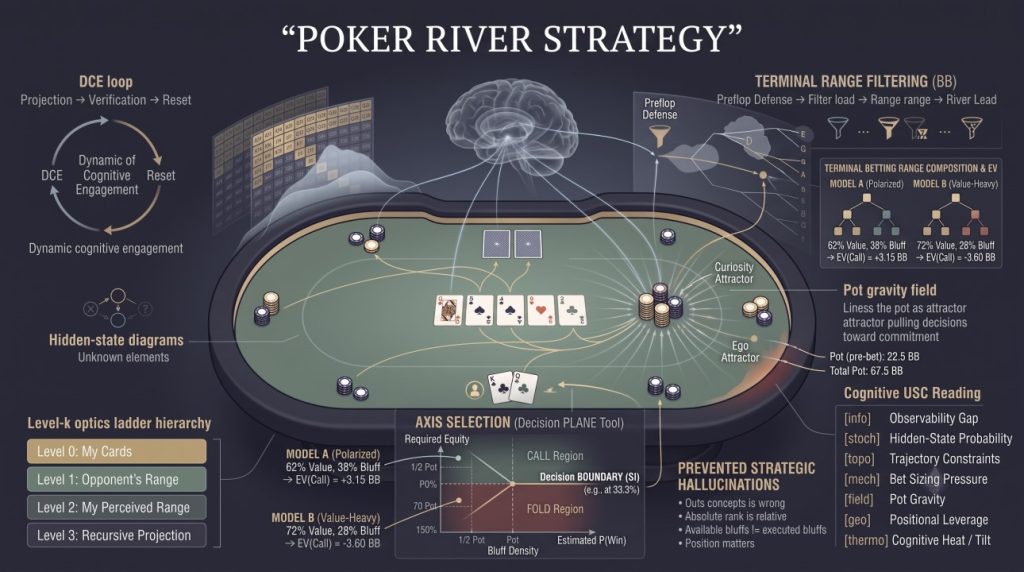
In our main river hand, Hero faces a pot-sized bet with a hand that can beat Villain’s bluffs but loses to most of Villain’s strong value bets.
This makes two questions load-bearing:
How often must Hero win
for the call to be profitable?

×

How much of Villain's betting Range
actually consists of bluffs?
The first question produces Required Equity.
The second introduces Bluff Density.
What Is Bluff Density?
Bluff Density is the proportion of Villain’s Terminal Betting Range that consists of bluffs rather than hands betting because they expect to be called by worse hands.
Suppose Villain arrives at the river with many possible hands, but after betting we estimate that their actual betting Range contains:
30 Strong Value Hands
+
15 Bluffs
The total betting Range contains:
45 combinationsand the Bluff Density is:
15 ÷ 45
=
33.3%
In plain language:
About one third of the hands Villain bets are bluffs.
This is different from asking how many missed draws Villain reached the river with.
Villain might arrive with:
30 missed drawsbut bluff only:
15of them.
Therefore:
Missed Draws Reaching River
≠
Executed Bluffs
and:
Bluff Density
=
Executed Bluffs
÷
Total Terminal Betting Range
For a bluff-catcher—a hand that usually loses to Villain’s value bets but beats their bluffs—this proportion can become extremely important.
If Hero beats essentially all bluffs and loses to essentially all value bets, then approximately:
Hero's Win Probability
≈
Villain's Bluff Density
The two primary axes of our river decision can therefore be written as:
Required Equity
×
Bluff Density in Villain's Terminal Betting Range
These axes describe two different sides of the same decision:
Required Equity
=
What the price demands

Bluff Density
=
What the opponent's betting Range provides
The river call becomes profitable when the second is sufficiently large relative to the first.
Everything else in the analysis—previous actions, missed draws, sizing, opponent type, table history, and Field effects—must ultimately help the Navigator estimate one of these two quantities or explain why the simple two-axis projection is insufficient.
- 1. The Hand Begins
- 2. Flop: The Hidden State Begins to Filter
- 3. Turn: Range Persistence
- 4. River: The Future Board Collapses
- 5. The First River Surprise: No Outs, but Probability Remains
- From Future Probability to Hidden-State Probability
- What Is a Terminal Range?
- Bluff-Catching Makes the Probability Clear
- 6. Expected Value on the River
- 7. Hero’s Hand Has Become a Bluff-Catcher
- 8. The River Range Is Not the Turn Range
- 9. Constructing the Terminal Betting Range
- 10. A Small Range Change Can Reverse the Decision
- 11. The Second River Surprise: Absolute Hand Strength Can Become Almost Irrelevant
- Opponent A: Bets Many Missed Draws
- Opponent B: Bets Very Strong Hands and Bluffs
- Opponent C: Almost Never Bluffs
- 12. Axis Selection in SKS: From River Chaos to Two Coordinates
- Active Strategic Invariant
- Axis 1 — Required Equity
- Axis 2 — Bluff Density / Actual Win Probability
- The River Decision Plane
- Why Two Axes Are Enough
- 13. False Axis Selection
- 14. Strategic Mechanics: Sizing Moves One Axis
- Half-Pot Bet
- Pot-Sized Bet
- 150% Pot Overbet
- 15. Sizing Can Move Both Axes at Once
- 16. The Third River Surprise: Bluffing Has No Future Rescue
- 17. Position Still Matters: What If the Opponent Checks?
- Question 1: Can Worse Hands Call?
- Question 2: Can Better Hands Fold?
- Question 3: What If Neither Happens?
- 18. What If the Navigator Must Act First?
- Betting First
- Checking
- Check-Fold
- Check-Call
- Check-Raise
- Position Changes the Meaning of Check
- 19. Axis Selection under Field Pressure
- Pot Gravity Substitutes the Pot for Bluff Density
- 20. Sunk Cost as Axis Substitution
- 21. Curiosity as Axis Substitution
- 22. Ego as Axis Substitution
- 23. The Purpose of the Field Audit
- 24. EV Is Often More Important, Not Less, on the River
- Facing a Bet
- Checked to in Position
- Acting First
- 25. River EV Is Only as Good as the Terminal Range
- 26. DCE: Projection, Verification, and Axis Reset
- Projection Movement
- Axis Selection
- Verification Movement
- Axis Reset
- 27. DSE: The River Model Must Obey Poker
- Vector A — SKS → Poker
- Vector B — Poker → SKS
- Preflop Filter
- Flop Filter
- Turn Filter
- River Action Filter
- 28. Active SI and Axis Selection across River Decisions
- Facing a Bet with a Bluff-Catcher
- Considering a Value Bet
- Considering a Pure Bluff
- Acting First and Considering a Check
- 29. USC Reading
- 30. Strategic Hallucinations Prevented through Axis Selection
- “I Have Top Pair, So I Should Call”
- “The Pot Is Too Big to Fold”
- “I Already Called Two Streets”
- “There Are Many Missed Draws”
- “I Need to See What He Has”
- “He Bluffed Me Earlier”
- 31. The River Navigator Protocol
- 32. The Complete Hand Revisited
- Active SI
- Axis Selection
- Axis 1
- Axis 2 — Model A
- Axis 2 — Model B
- The Strategic Lesson
- Conclusion: River Strategy Is the Selection of the Right Terminal Coordinates
- See Also
- FAQ
- What is Axis Selection in SKS Poker?
- What are the main axes when bluff-catching on the river?
- Why is hand strength not one of the primary axes?
- What is Required Equity?
- What equity is required against a pot-sized river bet?
- What is Bluff Density?
- Does probability still matter on the river?
- What is a Terminal Range?
- What is a Terminal Betting Range?
- What does polarized mean?
- Why can top pair be a fold?
- What should Hero do when the opponent checks?
- Why is checking different when Hero acts first?
- How does bet sizing affect Axis Selection?
- What is Axis Substitution?
- How does Pot Gravity distort Axis Selection?
- How does Curiosity distort the axes?
- How does Ego distort the axes?
- Does EV replace Axis Selection?
- What is the central SKS lesson?
1. The Hand Begins
Six-max table.
Hero is on the Button with:
K♣ Q♣Hero raises preflop.
The Big Blind calls.
The exact cards of the Big Blind are hidden.
Hero therefore begins with a preflop model:
R₀
=
Big Blind Defending Range
This may contain:
pocket pairs;
Qx;
suited kings;
suited aces;
suited connectors;
broadways;
selected weaker hands.
The exact composition depends on the opponent.
But one fact is already important:
The river Range will be created by the entire trajectory of the hand, not by the river card alone.
2. Flop: The Hidden State Begins to Filter
Flop:
Q♦ 8♠ 4♠Hero has:
K♣ Q♣Top pair with a strong kicker.
The Big Blind checks.
Hero bets.
The Big Blind calls.
The call does not reveal one exact hand.
It filters the hidden state-space.
Some hands become more plausible:
Qx;
8x;
sets;
pocket pairs;
spade draws;
straight draws;
selected weaker continuations.
Others lose weight.
So:
R₀
→ Flop
→ Check-Call
→ R₁
The opponent’s cards have not changed.
The Navigator’s projection of them has.
3. Turn: Range Persistence
Turn:
9♥Board:
Q♦ 8♠ 4♠ 9♥Big Blind checks again.
Hero bets.
Big Blind calls.
Another filter has been applied.
Possible surviving regions include:
Qx;
Q9;
98;
99;
88;
44;
spade draws;
JT;
T7;
76;
selected stubborn pairs.
Some weaker flop continuations disappear.
Thus:
R₁
→ Turn Card
→ Turn Call
→ R₂
This is Range Persistence.
A hidden state remains strategically relevant only if it can plausibly survive the cards, prices, and actions that occurred before the current decision.
The river therefore does not begin from the opponent’s entire preflop Range.
It begins from:
the portion of that Range
that survived the trajectory.
4. River: The Future Board Collapses
River:
2♣Final board:
Q♦ 8♠ 4♠ 9♥ 2♣The flush draw misses.
Several straight draws miss.
Big Blind now bets the size of the pot.
Assume the pot before the bet is:
22.5 BBVillain bets:
22.5 BBThe pot becomes:
45 BBHero must call:
22.5 BBto create a final pot of:
67.5 BBHero still holds:
K♣ Q♣The visible hand remains:
Top PairBut strategically, the state has changed completely.
5. The First River Surprise: No Outs, but Probability Remains
On the turn, Hero could ask:
What river cards improve me?That is an outs question.
On the river, outs disappear.
There is no future card.
Hero cannot improve.
Villain cannot improve.
The final hands already exist.
A beginner may therefore think:
No Future Cards
→ No Probability
But that is incorrect.
The uncertainty has moved.
Before the river:
Opponent Hand
×
Future River Card
were both unknown.
After the river:
Future River Card
→ Known
but:
Opponent Hand
→ Hidden
Probability now describes the Navigator’s uncertainty about which hidden state already exists.
From Future Probability to Hidden-State Probability
Suppose Villain reaches the river with:
100 plausible combinationsbut after the river card chooses to bet only:
40 combinationsHero does not make the call against all 100.
Hero makes the call against the 40 hands that belong to the betting Range.
Thus:
River Range
→ Villain Action
→ Terminal Betting Range
→ P(Hero Wins)
The opponent’s bet is therefore both:
a mechanical actionand:
new information.What Is a Terminal Range?
A Terminal Range is the set of opponent hands that can plausibly reach the final river state after all previous actions.
A Terminal Betting Range is the subset of those hands that the opponent actually bets.
So:
Terminal Range
≠
Terminal Betting Range
The distinction matters enormously.
A player can reach the river with many weak hands but choose to bet almost none of them.
Bluff-Catching Makes the Probability Clear
A bluff-catcher is a hand that:
beats Villain's bluffsbut:
loses to most hands
Villain bets because they expect
to be called by worse.
The second category is called value.
If Hero’s KQ loses to almost all of Villain’s value bets but beats almost every bluff, then:
P(Hero Wins)
≈
P(Villain Is Bluffing)
So the river question can become surprisingly simple:
How much of Villain's betting Range
is actually bluff?
6. Expected Value on the River
Expected Value asks:
Across all relevant possible hidden states, what is the average value of taking this action?
Facing the river bet, Hero has two main actions:
Fold
Call
If Hero folds:
EV(Fold) = 0from the current decision forward.
The chips invested earlier are already gone.
If Hero calls:
Call
→ Showdown
There is no future street.
No later bet.
No future community card.
This makes the calculation unusually clean.
Ignoring ties and rake:
EV(Call)
=
P(Win) × Pot Before Call
−
P(Loss) × Call Cost
Here:
Pot Before Call = 45 BB

Call Cost = 22.5 BB
Required equity:
22.5 ÷ 67.5
=
33.3%
Hero therefore needs to win approximately:
1 time in 3for the call to break even.
This gives us the first coordinate of the river decision.
Required Equity = 33.3%But the number does not tell Hero whether the call is good.
It tells Hero what must be true for the call to be good.
The second coordinate must come from the opponent’s Range.
7. Hero’s Hand Has Become a Bluff-Catcher
On the flop, KQ was clearly a strong hand.
Many weaker hands could call Hero’s bet.
On the turn, Hero could still be ahead of:
weaker Qx;
draws;
pairs;
other continuing hands.
But Villain then:
called flop;
called turn;
bet pot on river.
That trajectory changes the relevant hidden state-space.
Hero no longer asks:
Is top pair strong?Hero asks:
What part of Villain's river betting Range
does top pair beat?
Possible strong betting hands include:
Q9;
98;
99;
88;
44;
selected other strong hands.
Hero loses to those.
Possible bluffs include missed draws such as:
A♠5♠;
A♠3♠;
T♠7♠;
7♠6♠;
selected other missed draws.
Hero beats those.
So:
KQ
→ Bluff-Catcher
The strategic transformation is:
Same Hero Hand
+
Different Opponent Range
=
Different Strategic Function
8. The River Range Is Not the Turn Range
A common beginner mistake is:
Villain had many draws on the turn.

The draws missed.

Therefore Villain has many river bluffs.
One step is missing.
Suppose Villain reaches the river with:
20 missed drawsbut chooses to bluff only:
5and gives up with:
15Then:
Potential Bluff Candidates = 20

Executed River Bluffs = 5
Those are completely different strategic quantities.
Therefore:
A missed draw matters to Hero’s river call only if the opponent actually converts that missed draw into a bluff.
The structure is:
Missed Draw
→ Bluff Candidate
→ Opponent Decision
→ Bluff or Give-Up
This is why player behavior matters.
Two opponents can arrive at the same river with almost identical card Ranges but construct very different betting Ranges.
9. Constructing the Terminal Betting Range
For the teaching hand, suppose Hero estimates Villain’s pot-sized river betting Range as:
62% Value
38% Bluffs
These percentages are illustrative assumptions.
If Hero’s KQ loses to the value region and beats the bluff region:
P(Win) ≈ 38%The mechanical requirement is:
Required Equity = 33.3%So:
38% > 33.3%Call is profitable under the model.
Directly:
EV(Call)
=
0.38 × 45
−
0.62 × 22.5

=
17.10
−
13.95

=
+3.15 BB
Therefore:
Call10. A Small Range Change Can Reverse the Decision
Now change only the bluff frequency.
Suppose Villain bluffs:
28%Then:
P(Win) ≈ 28%EV:
EV(Call)
=
0.28 × 45
−
0.72 × 22.5

=
12.60
−
16.20

=
−3.60 BB
Now:
Foldis correct.
Nothing changed about:
Hero's cards;
the board;
the pot;
the call cost.
Only one coordinate changed:
Bluff DensityAnd that was enough to move the state across the decision boundary.
11. The Second River Surprise: Absolute Hand Strength Can Become Almost Irrelevant
A beginner naturally evaluates:
Pair
Two Pair
Straight
Flush
That hierarchy determines showdown ranking.
It does not directly determine the river decision.
Hero may think:
I have top pair with a good kicker.True.
But strategically incomplete.
The useful question is:
Top pair against what Range?Consider three opponents.
Opponent A: Bets Many Missed Draws
Villain’s betting Range contains:
strong hands
+
many missed draws
+
some weaker hands
Against this Range:
KQcan be a profitable call.
Opponent B: Bets Very Strong Hands and Bluffs
This structure is often called a polarized Range.
For beginners, that simply means:
The opponent bets mainly hands from two distant ends of the Range: very strong hands and weak hands used as bluffs, with relatively few medium-strength hands between them.
Conceptually:
Very Strong
+
Bluff
with fewer:
Medium HandsAgainst this Range, KQ becomes a classic bluff-catcher.
Its absolute rank matters much less than:
How much bluff exists?Opponent C: Almost Never Bluffs
Suppose the pot-sized river bet means:
mostly two pair or better
+
almost no bluffs.
Now:
KQ
→ Fold
may be obvious.
Across all three opponents:
Hero Hand = Same
Board = Same
Only the opponent’s Terminal Betting Range changes.
Therefore:
Absolute Hand Strength
≠
River Decision Strength
12. Axis Selection in SKS: From River Chaos to Two Coordinates
The previous example reveals why Axis Selection is a core SKS tool.
A river state is multidimensional.
The Navigator could think about:
Hero's hand rank;
pot size;
previous investment;
opponent personality;
previous bluffs;
table image;
fear of folding;
curiosity;
bet sizing;
missed draws;
possible value hands;
status at the table.
Trying to optimize over every dimension simultaneously produces cognitive noise.
SKS therefore asks:
Which two strategic coordinates actually separate the available actions?
For the current bluff-catching decision, the Active SI tells us which axes matter.
Active Strategic Invariant
The applied river SI is:
A terminal call is profitable when Hero’s probability of winning against the opponent’s Terminal Betting Range exceeds the equity required by the price of the call.
Therefore:
Axis Selection
=
f(Active SI)
The SI generates the axes.
Axis 1 — Required Equity
This is the mechanical threshold.
It comes from:
Pot
+
Opponent Bet
+
Call Cost
For the pot-sized bet:
Required Equity = 33.3%This axis belongs primarily to:
[mech] Strategic MechanicsAxis 2 — Bluff Density / Actual Win Probability
For a pure bluff-catcher:
P(Win)
≈
Bluff Density
This comes from the composition of the opponent’s Terminal Betting Range.
This axis belongs primarily to:
[info] Information Theory

×

[stoch] Stochastic Theory
So the entire decision can be projected onto:
Required Equity
×
Bluff Density
The River Decision Plane
For this particular hand:
Required Equity = 33.3%If:
Bluff Density > 33.3%then:
Call = +EVIf:
Bluff Density < 33.3%then:
Fold = Higher EVConceptually:
               Bluff Density
                     ▲
                     │
              CALL   │   +EV Call Region
                     │
            38%  •   │
                     │
        33.3% ───────┼──── Decision Boundary
                     │
            28%  •   │
                     │   -EV Call Region
              FOLD   │
                     └──────────────────────►
                         Required Equity
For the actual pot-sized bet:
Required Equity
=
33.3%
So the decision depends on whether the projected bluff frequency lies above or below that threshold.
Why Two Axes Are Enough
The board still matters.
Past actions still matter.
Opponent history still matters.
But those inputs should ultimately modify one of the selected coordinates.
For example:
Opponent Rarely Bluffs River
→ Bluff Density ↓
or:
Opponent Uses Huge Bets with Many Bluffs
→ Bluff Density ↑
Similarly:
Opponent Bet Size ↑
→ Required Equity ↑
The other observations become inputs into the axes, not additional decision axes competing for attention.
That is the purpose of Axis Selection.
13. False Axis Selection
The beginner may unconsciously choose:
Hand Strength
×
Pot Size
and conclude:
Top Pair
+
Huge Pot
→ Too Strong to Fold
This coordinate system is strategically misleading.
Neither coordinate directly determines whether the call is profitable.
Another false projection is:
Past Investment
×
Fear of Being Bluffed
Again, neither defines the EV boundary.
Correct Axis Selection resets the decision to:
Required Equity
×
P(Win | Terminal Betting Range)
For a pure bluff-catcher:
Required Equity
×
Bluff Density
This is the river equivalent of removing cognitive noise.
14. Strategic Mechanics: Sizing Moves One Axis
Villain’s bet mechanically changes the price.
Suppose the pot before Villain acts is:
22.5 BBCompare three sizes.
Half-Pot Bet
Villain bets:
11.25 BBRequired equity:
11.25 ÷ 45
=
25%
Pot-Sized Bet
Villain bets:
22.5 BBRequired equity:
22.5 ÷ 67.5
=
33.3%
150% Pot Overbet
An overbet is simply a bet larger than the current pot.
Villain bets:
33.75 BBRequired equity:
33.75 ÷ 90
=
37.5%
So:
Bet Size ↑
→ Price of Commitment ↑
→ Required Equity ↑
In the selected coordinate system, Strategic Mechanics moves the state along the:
Required Equity Axis15. Sizing Can Move Both Axes at Once
The complication is that sizing is also information.
Different bet sizes may come from different opponent Ranges.
A small bet may contain:
medium-strength hands
trying to get called;

very strong hands;

occasional bluffs.
A huge bet may come mainly from:
very strong hands
+
selected weak hands used as bluffs.
Again, this is what polarized means.
So sizing affects:
Axis 1:
Required Equity
and may also change:
Axis 2:
Bluff Density / P(Win)
This is important.
A large bet may move the decision boundary upward:
Required Equity ↑while simultaneously making the opponent’s betting Range:
strongeror, against an aggressive player:
more bluff-heavy.So Hero cannot say merely:
Large Bet
→ Need More Equity
The full reading is:
Bet Size
→ Required Equity

and

Bet Size
→ Information about Betting Range
→ Estimated P(Win)
Strategic Mechanics and Information Theory interact.
16. The Third River Surprise: Bluffing Has No Future Rescue
On earlier streets, a semi-bluff can succeed because:
Opponent Foldsor:
Opponent Calls
→ Hero Improves Later
The river eliminates the second path.
For a pure river bluff with no showdown value:
EV(Bluff)
=
P(Fold) × Pot
−
P(Call) × Bet
Suppose:
Pot = 100
Bet = 75
Break-even fold frequency:
75 ÷ 175
≈ 42.9%
The bluff needs the opponent to fold more than about:
43%There is no future river card to rescue Hero after a call.
This makes the river the cleanest form of:
Response-Space Compression17. Position Still Matters: What If the Opponent Checks?
The board is complete.
But information is not equally distributed.
Suppose Villain checks to Hero.
Hero is in position.
Sequence:
Villain Checks
→ Hero Observes
→ Hero Chooses
Hero now has:
Check Back
or
Bet
If Hero checks back:
Immediate Showdownis guaranteed.
That gives Hero a valuable terminal option.
Question 1: Can Worse Hands Call?
Suppose Hero has:
KQand believes Villain can call a bet with:
QJ;
QT;
9x;
selected weaker hands.
Then a bet may earn additional chips from hands Hero beats.
That is a value bet.
For beginners:
A value bet is a bet made because Hero expects enough worse hands to call.
The relevant axis pair can become:
Bet Size
×
Worse-Call Density
Question 2: Can Better Hands Fold?
Suppose Hero instead holds a very weak hand.
If a bet can make enough better hands fold:
Bet
→ Better Hands Exit
Hero may have a profitable bluff.
The useful axes become:
Bet Cost
×
Fold Probability
Question 3: What If Neither Happens?
Suppose Hero has a medium-strength hand.
If betting produces:
Worse Hands → Fold

Better Hands → Call
the bet may improve nothing.
In that state:
Check Backcan be best.
A useful beginner rule is:
When checked to on the river, bet if worse hands can call or better hands can fold. If neither happens often enough, strongly consider checking back.
This is not a universal rule.
It is a clean first projection.
18. What If the Navigator Must Act First?
Now Hero is out of position.
Hero acts before Villain.
This changes the topology.
If Hero checks:
Hero Check
≠
Automatic Showdown
Villain can still bet.
So Hero compares:
Betagainst:
Check
→ Villain Response
The second branch remains open.
Betting First
Hero can bet if the expected response distribution makes betting profitable.
Again:
Worse Callscan support value.
Or:
Better Foldscan support a bluff.
Checking
Hero may check a medium-strength hand because betting would cause:
Worse Hands Fold
+
Better Hands Continue
But Hero must already think one step ahead:
If Villain bets,
what will I do?
Possible plans include:
Check-Fold
Check
→ Villain Bets
→ Fold
Useful when Villain’s betting Range is too strong.
Check-Call
Check
→ Villain Bets
→ Call
Useful when Villain includes enough:
bluffs
or
worse value bets.
Check-Raise
Check
→ Villain Bets
→ Raise
This is more advanced and requires a much more accurate model.
Position Changes the Meaning of Check
In position:
Opponent Checks
→ Hero Checks
→ Showdown
Out of position:
Hero Checks
→ Opponent Still Acts
Therefore:
River position is control over whether the Navigator receives the opponent’s final information before committing.
No future cards remain.
But information geometry remains.
19. Axis Selection under Field Pressure
Now return to our main hand.
Hero faces the pot-sized river bet.
The correct axes are:
Required Equity
×
Bluff Density
But the river produces strong psychological pressure.
This is where Strategic Field Theory becomes important.
Field pressure often works by causing Axis Substitution.
The Navigator begins with the correct coordinates, but an attractor silently replaces one of them.
Pot Gravity Substitutes the Pot for Bluff Density
Correct axis:
How often am I actually winning?Field substitution:
The pot is huge.The Navigator begins evaluating:
Hand Strength
×
Pot Size
instead of:
Required Equity
×
Bluff Density
That is a Projection Mismatch.
20. Sunk Cost as Axis Substitution
Hero remembers:
preflop investment;
flop bet;
turn bet;
the time spent in the hand.
The thought appears:
I have already put too much in to fold.But the past investment is not part of the current EV calculation.
The correct axis:
Estimated Win Probabilityis silently replaced by:
Amount Already InvestedThus:
Sunk-Cost Attractor
→ Axis Substitution
Strategically:
Past Investment
≠
Current Call Justification
21. Curiosity as Axis Substitution
Calling may reveal Villain’s cards.
Folding may leave uncertainty unresolved.
Hero thinks:
I just want to see what he has.Now:
Chip EVis being replaced by:
Utility of Removing UncertaintyThe Navigator may pay for information without consciously recognizing the change.
So:
Curiosity Attractor
→ P(Win) Axis Replaced
by
Uncertainty-Removal Utility
For ordinary chip-EV analysis, that is distortion.
22. Ego as Axis Substitution
Suppose Villain showed Hero a bluff earlier.
Hero now thinks:
He is trying to push me around again.

I am not folding.
The correct axis:
Value / Bluff Compositionis replaced by:
Dominance / StatusThe cards did not change.
The price did not change.
But Hero’s coordinate system did.
That is a Field Theory failure before it becomes an EV failure.
23. The Purpose of the Field Audit
The Field Audit asks:
Am I still using
the axes selected by the Active SI?
For the main bluff-catching decision:
Required Equity
×
Bluff Density
should remain load-bearing.
Field variables are relevant only if they legitimately change one of those coordinates.
For example:
Villain becomes angry
and starts over-bluffing
is relevant because:
Bluff Density ↑But:
I feel angry because Villain bluffed me earlierdoes not change Villain’s current Range by itself.
That distinction is critical.
24. EV Is Often More Important, Not Less, on the River
The river removes several complications.
There are:
No Future Community Cards
No Later Street after a Terminal Call
No Future Draw Realization
No Future Implied Payment after the Decision
The remaining branches become unusually clear.
Facing a Bet
Hero compares:
Fold
vs.
Call
This maps naturally onto:
Required Equity
×
P(Win)
Checked to in Position
Hero compares:
Check Back
vs.
Bet
Now Axis Selection changes.
For a value decision, useful axes might become:
Worse-Call Density
×
Bet Size
For a bluff:
Fold Probability
×
Bet Cost
The Active SI changes, so the axes change.
Acting First
Hero compares:
Betagainst:
Check
→ Opponent Response
The response tree is larger.
Now relevant coordinates may include:
Opponent Bet Frequency
×
Hero Equity versus that Betting Range
This shows an important SKS principle:
There is no universal poker axis pair. The Active SI selects the axes for the specific decision.
25. River EV Is Only as Good as the Terminal Range
Suppose Hero calculates:
Required Equity = 33.3%perfectly.
This coordinate is mechanically exact.
But Hero estimates:
Bluff Density = 38%That is a model.
If the true bluff density is:
28%the decision reverses.
So:
Exact Mechanical Axis
+
Approximate Information Axis
→ Approximate Strategic Decision
The arithmetic can be exact while the projection is wrong.
This is why Axis Selection does not eliminate Range construction.
It disciplines it.
The Navigator knows exactly which Range property must be estimated.
Not:
What does Villain have?but:
How much of Villain's betting Range
produces a Hero win?
That is a much better cognitive question.
26. DCE: Projection, Verification, and Axis Reset
DCE — Dual Cognitive Encoding — is especially useful on the river.
Projection Movement
Hero sees:
Top Pair
+
Missed Spades
+
Pot-Sized Bet
and forms:
Villain can bluff.
Maybe I should call.
This is a candidate abstraction.
Axis Selection
Before acting, the Navigator asks:
What SI governs the decision?Answer:
Call is profitable
if P(Win) exceeds Required Equity.
So the axes become:
Required Equity
×
P(Win)
or for the pure bluff-catcher approximation:
Required Equity
×
Bluff Density
Verification Movement
Hero now checks:
Which missed draws reach river?

Which ones actually bet?

Which strong hands take this line?

What does this sizing mean
for this opponent?

Does this player bluff enough?
Axis Reset
Then Hero checks for distortion:
Am I using:
Required Equity × Bluff Density?

Or did I drift into:
Top Pair × Huge Pot?

Past Investment × Fear?

Curiosity × Ego?
If the axes drifted:
Reset.This gives the full DCE river loop:
Projection
→ Active SI
→ Axis Selection
→ Verification
→ Axis Reset
→ Action
27. DSE: The River Model Must Obey Poker
DSE — Dual Scientific Encoding — constrains the Range model with the actual domain.
Vector A — SKS → Poker
SKS provides concepts such as:
Hidden State
Range
Terminal Range
Axis
Decision Boundary
Response-Space
Trajectory
These make the hand strategically legible.
Vector B — Poker → SKS
Poker constrains the model through:
legal cards;
board;
Hero cards;
preflop actions;
flop actions;
turn actions;
river sizing;
stack sizes;
position;
actual player behavior.
Return to the trajectory:
BB calls preflop
→ checks and calls flop
→ checks and calls turn
→ bets pot on river
Every step filters the Range.
Preflop Filter
Some hands:
3-bet instead;
fold instead.
They receive lower or zero weight in the calling Range.
Flop Filter
On:
Q♦ 8♠ 4♠many complete misses may fold.
Pairs and draws persist more often.
R₀
→ R₁
Turn Filter
Villain calls again on:
9♥More weak states disappear.
R₁
→ R₂
River Action Filter
Villain bets pot.
Now:
R₂
→ River Bet
→ Terminal Betting Range
Hero must determine:
Which strong hands bet?

Which missed draws bluff?

Which medium hands check instead?
DSE therefore converts:
He could have missed spades.into:
Which legal missed-spade combinations
survived the line
and are actually converted into bets?
That is a much stronger model.
28. Active SI and Axis Selection across River Decisions
The river does not have one universal SI.
Different decisions activate different invariants.
Facing a Bet with a Bluff-Catcher
Active SI:
Call only if actual win probability exceeds the price-imposed threshold.
Axes:
Required Equity
×
Bluff Density / P(Win)
Considering a Value Bet
Active SI:
Bet only if expected value gained from worse continuing hands exceeds the cost of adverse responses.
Beginner axes:
Worse-Call Density
×
Bet Size
Considering a Pure Bluff
Active SI:
Bluff only if the probability-weighted value of folds exceeds the cost of being called.
Axes:
Fold Probability
×
Bet Cost
Acting First and Considering a Check
Active SI:
Check is preferable when preserving the opponent’s response branch creates more EV than betting directly.
Possible axes:
Opponent Bet Frequency
×
Hero Equity versus Betting Range
The methodological rule is constant:
Active SI
→ Axis Selection
→ Decision Projection
29. USC Reading
| USC Lens | River Reading |
|---|---|
[info] Information Theory | Previous streets and river action determine which hidden hands remain plausible and how much bluff/value mass exists. |
[stoch] Stochastic Theory | Future-card uncertainty disappears, but uncertainty over hidden-state and behavioral probabilities remains. |
[mech] Strategic Mechanics | Bet size creates the Required Equity axis by determining the Price of Commitment. |
[field] Strategic Field Theory | Pot Gravity, Curiosity, Ego, and sunk-cost pressure can substitute irrelevant axes for the correct decision coordinates. |
[topo] Strategic Topology | The river closes future-card paths and reduces the remaining decision tree toward terminal actions. |
[geo] Strategic Geometry | Position determines whether the Navigator receives the opponent’s final action before committing. |
[thermo] Strategic Thermodynamics | Fear, frustration, regret, and bluff-catching anger generate Cognitive Heat that makes Axis Drift more likely. |
For our main river call, the load-bearing USC structure is:
[mech]
Required Equity

×

[info] × [stoch]
Bluff Density / P(Win)

→

EV Boundary
Field Theory then performs the audit:
[field] × [thermo]
→
Did the Navigator keep the correct axes?
30. Strategic Hallucinations Prevented through Axis Selection
“I Have Top Pair, So I Should Call”
False axes:
Absolute Hand Rank
×
Emotional Confidence
Correct axes:
Required Equity
×
P(Win)
“The Pot Is Too Big to Fold”
False axis:
Pot Size as Emotional ImportanceCorrect role of pot:
Pot Size
→ Required Equity Calculation
“I Already Called Two Streets”
False axis:
Past InvestmentPast chips are sunk.
“There Are Many Missed Draws”
False axis:
Available Bluff CandidatesCorrect axis:
Executed Bluff Density“I Need to See What He Has”
False axis:
CuriosityCorrect axis:
Chip EV“He Bluffed Me Earlier”
Historical evidence may modify:
Bluff Density Estimatebut it must not replace the axis with:
Ego / Revenge31. The River Navigator Protocol
Before making a river decision:
1. What changed on the river?

2. Which turn Range states survive?

3. Which draws completed?

4. Which draws missed?

5. What action did the opponent take?

6. Identify the Active SI:
   What relation actually separates
   the available actions?

7. AXIS SELECTION:

   For a bluff-catch:
   Axis 1 = Required Equity
   Axis 2 = Bluff Density / P(Win)

   Discard as primary axes:
   Past Investment
   Absolute Hand Rank
   Ego
   Curiosity
   Fear of Being Bluffed

8. Determine Axis 1:
   What does the opponent's sizing
   require mathematically?

9. Determine Axis 2:
   What part of the Terminal Betting Range
   does Hero actually beat?

10. Project the current state
    onto the two selected axes.

11. Is P(Win) above
    or below Required Equity?

12. Check whether sizing
    also changes Range interpretation.

13. FIELD AUDIT:
    Did Pot Gravity,
    Curiosity,
    Ego,
    sunk cost,
    or Cognitive Heat
    substitute a false axis?

14. If opponent checked:
    - Can worse hands call?
    - Can better hands fold?
    - If neither, consider checking back.

15. If Hero acts first:
    - What happens if Hero checks?
    - How often does Villain bet?
    - What does Hero do against that bet?

16. Act.

17. Use showdown evidence
    to update future Range models.
Compressed:
River State
→ Active SI
→ Axis Selection
→ Terminal Range
→ EV Boundary
→ Field Audit
→ Final Action
→ Evidence
→ Update
32. The Complete Hand Revisited
Hero:
K♣ Q♣Board:
Q♦ 8♠ 4♠ 9♥ 2♣Trajectory:
Preflop:
BTN raise
BB call

Flop:
BB check
Hero bet
BB call

Turn:
BB check
Hero bet
BB call

River:
BB bets pot
Surface thinking says:
I have top pair.

The flush missed.

The pot is huge.

Maybe he is bluffing.
SKS compresses the state differently.
Active SI
Call is profitable
if Hero's probability of winning
exceeds Required Equity.
Axis Selection
Axis 1:
Required Equity

Axis 2:
Bluff Density / P(Win)
Axis 1
Pot-sized bet:
Required Equity = 33.3%Axis 2 — Model A
Suppose:
Bluff Density = 38%Then:
38% > 33.3%and:
EV(Call) = +3.15 BBSo:
CallAxis 2 — Model B
Suppose:
Bluff Density = 28%Then:
28% < 33.3%and:
EV(Call) = −3.60 BBSo:
FoldThe Strategic Lesson
Hero’s hand remained:
Top PairThe pot remained:
the same potThe required equity remained:
33.3%Only the second strategic coordinate changed.
That moved the decision from one regime to another.
This is exactly what Axis Selection is designed to expose.
Conclusion: River Strategy Is the Selection of the Right Terminal Coordinates
The river does not remove uncertainty.
It compresses uncertainty.
Earlier streets contain:
Hidden Hand
+
Future Cards
+
Future Bets
On the river:
Future Cards = 0And after a terminal call:
Future Bets = 0The state becomes easier to describe.
But it also becomes easier for irrelevant variables to hijack cognition.
The Navigator sees:
a strong-looking hand;
a large pot;
past investment;
missed draws;
a provocative opponent;
a final irreversible decision.
Without methodological discipline, all of these dimensions compete for attention.
SKS does not solve the problem by thinking about more variables.
It solves it by selecting the right ones.
For the central bluff-catching decision:
Active SI
→
P(Win) must exceed Required Equity
therefore:
Axis Selection
→
Required Equity
×
Bluff Density / P(Win)
Everything else has one of three roles.
It may determine the first axis:
Sizing
→ Required Equity
It may update the second axis:
Opponent History
→ Bluff Density Estimate
Or it may be noise:
Sunk Cost
Ego
Curiosity
Fear
Field Theory becomes especially important because attractors often work by secretly changing the coordinate system.
Correct Axes:
Required Equity
×
P(Win)

Field Distortion:
Pot Size
×
Ego
The Field Audit therefore asks:
Am I still solving the decision defined by the Active SI, or has the strategic field made me solve a different problem?
This connects the entire river architecture:
Previous Range
→ River Card
→ Opponent Action
→ Active SI
→ Axis Selection
→ Terminal Range Projection
→ EV Boundary
→ Field Audit
→ Final Action
The first major lesson is:
No future cards does not mean no probability.
Probability has moved from:
What card will come?to:
What hidden state already exists?The second lesson is:
Absolute hand strength is not the river decision axis.
The same top pair can be:
Call
or
Fold
against different Terminal Betting Ranges.
The third lesson is:
Potential bluffs are not actual bluffs.
Only executed bluffs belong on the Bluff Density axis.
The fourth lesson is:
Sizing can move both sides of the state.
It changes:
Required Equityand can also change:
Range Interpretation.The fifth lesson is:
Position still matters because it controls terminal observability.
A check in position can end the betting.
A check out of position can open another response branch.
The sixth lesson is:
EV becomes unusually transparent on the river—but only after the correct axes have been selected.
And the final SKS lesson is broader than poker:
Strategic cognition does not require the Navigator to represent every dimension of reality at once. It requires the Navigator to identify the Active Strategic Invariant and select the axes on which the decision actually changes regime.
On the river:
Wrong Axes
→ Narrative

Correct Axes
→ Decision Boundary
Or more compactly:
On the flop, the Navigator asks what can develop.
On the turn, which trajectories can survive.
On the river, which terminal states remain—and on which axes the final decision changes from +EV to −EV.
That is Poker River Strategy through SKS.
See Also
- Ranges and Expected Value: Thinking Beyond Exact Hands
- Preflop Strategy in SKS Poker
- Bluff as Response-Space Compression
- Strategic Field Theory in Poker
- Bet Sizing as Response-Space Manipulation
- Combinatorial Blockers and the Physics of Removal
FAQ
What is Axis Selection in SKS Poker?
Axis Selection is the process of projecting a complex strategic state onto the two most decision-relevant coordinates determined by the Active Strategic Invariant.
What are the main axes when bluff-catching on the river?
For a simple bluff-catcher:
Required Equity
×
Bluff Density / P(Win)
Why is hand strength not one of the primary axes?
Because absolute hand rank does not determine whether the call is profitable. What matters is how often that hand wins against the opponent’s actual betting Range.
What is Required Equity?
It is the minimum probability of winning required to justify a call at the price offered by the opponent.
What equity is required against a pot-sized river bet?
Approximately:
33.3%What is Bluff Density?
It is the proportion of the opponent’s Terminal Betting Range made of bluffs. For a pure bluff-catcher, this may closely approximate Hero’s probability of winning.
Does probability still matter on the river?
Yes. Future-card probability disappears, but uncertainty over the opponent’s hidden hand remains.
What is a Terminal Range?
The set of opponent hands that can plausibly survive the entire trajectory and reach the river.
What is a Terminal Betting Range?
The subset of the Terminal Range that the opponent actually chooses to bet.
What does polarized mean?
A polarized betting Range contains mainly very strong hands and weak hands used as bluffs, with relatively few medium-strength hands between them.
Why can top pair be a fold?
Because top pair may win too rarely against the opponent’s Terminal Betting Range to justify the price of calling.
What should Hero do when the opponent checks?
Ask whether worse hands can call a bet or better hands can fold. If neither occurs often enough, checking back may be best.
Why is checking different when Hero acts first?
Because checking out of position does not guarantee showdown. The opponent can still bet.
How does bet sizing affect Axis Selection?
Sizing directly determines Required Equity and may also provide information that changes Hero’s estimate of the opponent’s betting Range.
What is Axis Substitution?
It occurs when an irrelevant field variable replaces one of the correct strategic axes—for example, when sunk cost replaces Bluff Density in the Navigator’s reasoning.
How does Pot Gravity distort Axis Selection?
It can make the size of the pot feel like an independent reason to call rather than using pot size only to calculate the correct mechanical threshold.
How does Curiosity distort the axes?
Curiosity can substitute the subjective value of seeing the opponent’s cards for chip EV.
How does Ego distort the axes?
Ego can substitute status or dominance for the actual value/bluff composition of the opponent’s Range.
Does EV replace Axis Selection?
No. Axis Selection determines what should enter the EV comparison. EV then separates the resulting state into profitable and unprofitable actions.
What is the central SKS lesson?
Active SI
→ Axis Selection
→ EV Boundary
→ Action
The Navigator does not solve the river by thinking about every available variable. The Navigator solves it by selecting the coordinates on which the decision actually changes regime.