
- Position
- Surface Perception
- The Hidden Projection
- Active Strategic Invariant
- Correct Axes
- Decision Process of the Navigator
- Step 1: Queen sacrifice as first trigger
- Step 2: Rook sacrifice as second decoy
- Step 3: Clearance and discovered mate
- DCE Loop in the Position
- Vector A: Abstraction
- Vector B: Verification
- DCE Summary
- Tactical Motifs in the Combination
- Strategic Cognition Lesson
Position
FEN: 5kr1/ppp1r1pR/1q1p1p2/1b3P1B/4P3/1Q6/PPP3P1/1K5R w - - 0 1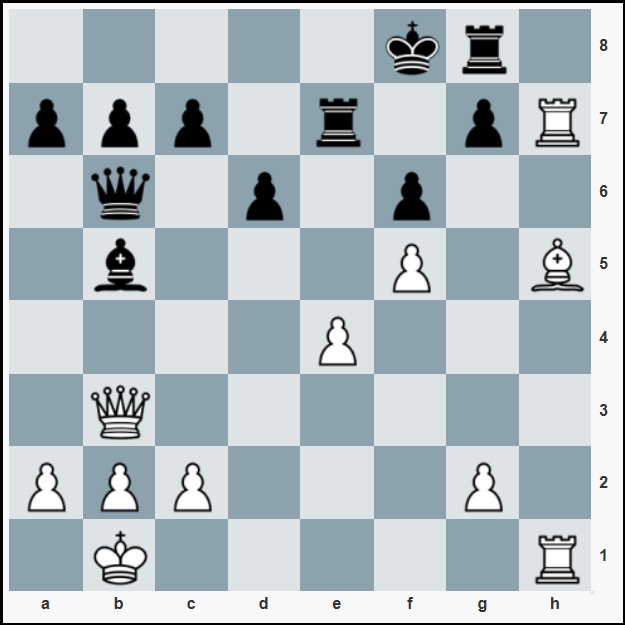
White to move.
Surface Perception
A weaker player may first see the position through material and visible threats.
They may ask:
Can White win material?
Is the black king really exposed?
Is the queen sacrifice sound?
Can Black simply take everything?
This is the surface projection.
From this view, 1. Qxg8+! looks dangerous because White is offering the queen to the king. Then 2. Rh8+! looks even more extreme because White sacrifices a rook as well.
The material balance seems to scream:
White is giving away too much.But the board is governed by a different structure.
The real question is not:
How much material is White sacrificing?The real question is:
Where must the black king be placed so that the hidden h-file attack becomes terminal?This is the shift from material evaluation to tactical cognition.
The Hidden Projection
The hidden structure of the position is the h-file.
White has a rook on h1.
White has a bishop on h5.
White has a rook on h7.
The black king begins on f8.
The black rook on g8 stands between the initial position and the final tactical geometry.
At first, the h-file is not open because the bishop on h5 blocks the rook on h1. But this is exactly the point: the bishop is not merely a piece. It is a movable blocker.
If the bishop can leave h5 with tempo, the rook on h1 will suddenly project force up the h-file.
The Navigator must therefore see the position as a latent line problem:
The h-file is closed on the surface,
but tactically ready to become open.
This makes Bf7# the terminal clearance move.
The bishop moves away from h5, opens the rook line, and at the same time covers g8, removing the king’s escape square.
Active Strategic Invariant
The Active SI of the position is:
The black king can be forcibly relocated to h8, where the h-file becomes a terminal mating corridor after the bishop vacates h5.This invariant remains stable through the forcing sequence.
It is not about material.
It is not about general activity.
It is not about winning the rook on g8.
It is not even about the queen sacrifice by itself.
The queen sacrifice is only the first trigger.
The actual invariant is the forced convergence of the black king into the h-file mating corridor.
A shorter formulation:
Forced King Relocation + h-file Clearance = Discovered Rook Mateor:
The king is dragged into the line that is opened only at the final moment.Correct Axes
The correct axes for this position are:
King Mobility × Attacker Delivery
Line Openness × Blockade
Decoy × Forced Coordinate Shift
Surface Observation ↔ Latent Projection
Verification Cost × Forced Corridor
The wrong axes are:
Material Count
Queen Value
Rook Value
Static Piece Activity
A player who remains on the material axis will reject the combination too early.
A player who sees the Active SI understands that material is no longer the governing coordinate. White is not paying material randomly. White is purchasing king relocation, h-file clearance, and terminal trajectory compression.
Decision Process of the Navigator
The Navigator’s decision process begins with a tactical warning:
The black king has restricted mobility.
White has heavy pieces on the h-file.
The bishop on h5 blocks the rook on h1 but can move.
The black rook on g8 and the black king form a forcing target.
The first candidate idea is:
Can the black king be forced onto h8?This question immediately changes the projection.
The Navigator no longer asks whether the queen can be preserved. The Navigator asks whether the queen can function as a decoy and trigger.
Step 1: Queen sacrifice as first trigger
1. Qxg8+!White captures the rook on g8 and gives check.
This move performs several functions at once:
it removes the rook from g8;
it forces the black king to respond;
it pulls the king toward the h-file geometry;
it begins the collapse of Black’s effective trajectory space.
Black’s reply is forced:
1...Kxg8The black king captures the queen, but this capture is not a victory. It is the first step into the corridor.
Step 2: Rook sacrifice as second decoy
2. Rh8+!White now sacrifices the rook from h7.
This is a second forcing move.
The rook does not move to survive. It moves to pull the king one square farther into the prepared line.
Black again appears to win material:
2...Kxh8But now the king is exactly where White wanted it: on h8.
The black king has been decoyed into the h-file.
Step 3: Clearance and discovered mate
3. Bf7#This is the decisive cognitive moment.
The bishop leaves h5.
The h-file opens.
The rook on h1 gives check along the open file.
The move is not only a bishop move. It is a clearance operation that activates the hidden rook.
At the same time, the bishop on f7 controls g8, preventing the king from escaping.
The final position is a closure of the king’s effective trajectory space:
Ω_king → 0This is mate not because White “attacks strongly,” but because the black king has no viable future coordinate.
DCE Loop in the Position
This position is a clean example of Dual Cognitive Encoding.
DCE means that the Navigator first compresses the visible position into a candidate projection, then returns to the concrete legal structure of the board to verify whether that projection survives.
Vector A: Abstraction
The Navigator forms the candidate tactical SI:
The h-file is a latent mating corridor.
The bishop on h5 is a movable blocker.
The black king can be forced to h8.
The queen and rook sacrifices are not material losses but decoy mechanisms.
The final bishop move will open the h-file and reveal the rook check.
This is the beautiful idea.
But it is not yet truth.
Vector B: Verification
The Navigator must now verify the sequence:
Does 1. Qxg8+ force the king toward the corridor?
After 1...Kxg8, does 2. Rh8+ force the king to h8?
After 2...Kxh8, can the bishop vacate h5 with check?
Does 3. Bf7# open the h-file completely?
Does the bishop on f7 cover g8?
Can Black interpose on the h-file?
Can Black capture the rook on h1?
Does the king have any escape square?
The concrete answer confirms the projection.
After 3. Bf7#, the h-file is open, the rook on h1 gives check, the king cannot escape to g8, and no defensive resource interrupts the line.
The candidate SI becomes verified.
DCE Summary
Position
→ Candidate SI: h-file mating corridor after forced king relocation
→ Axis Selection: King Mobility × Attacker Delivery; Line Openness × Blockade
→ Candidate Move: 1. Qxg8+!
→ Concrete Variation: 1...Kxg8 2. Rh8+ Kxh8 3. Bf7#
→ Verification: no escape, no interposition, no replacement defense
→ SI verified
This is exactly why DCE matters.
A player who only completes Vector A may see a beautiful sacrifice but fail to prove it. A player who completes Vector B confirms that the sacrifice is not aesthetic, but structurally forced.
Tactical Motifs in the Combination
This example combines several tactical motifs into one forced corridor.
| Motif | Function in the Position |
|---|---|
| Decoy | The queen and rook sacrifices lure the black king from f8 to g8 and then to h8. |
| Destruction of the Defender | 1. Qxg8+! removes the rook on g8, clearing the critical tactical zone. |
| Line Opening / Clearance | 3. Bf7# moves the bishop away from h5 and opens the h-file for the rook on h1. |
| Discovered Check | The final check is delivered by the rook on h1 after the bishop vacates the line. |
| Mating Net | The king’s effective trajectory space collapses to zero after the forced relocation. |
| Forced Corridor | Black’s replies are not free strategic choices; they are forced steps into the mating geometry. |
The combination is powerful because these motifs do not operate separately. They converge into one tactical invariant.
Strategic Cognition Lesson
The strongest move in this position is not found by asking:
What can I capture?or:
How much material can I win?It is found by asking:
What hidden line can become decisive if the king is forced onto the right square?The queen and rook sacrifices are not romantic gestures. They are coordinate-forcing operations.
White does not “attack” in a general sense. White transforms the position:
Closed h-file
→ forced king relocation
→ h-file clearance
→ discovered rook check
→ mate
The deep lesson is:
A tactic becomes visible when the Navigator stops seeing pieces as material objects and starts seeing them as functions inside a forced trajectory.In this position, White’s queen and rook are not preserved because their material value is lower than their tactical function.
Their function is to move the king.
Once the king reaches h8, the final move Bf7# reveals the hidden truth of the position: the h-file was not blocked. It was waiting.