
Take a fresh look at olympiad combinatorics through the lens of Strategy Knowledge Science
A combinatorial game seems to ask a simple question:
What move should I make?
For an olympiad solver, this is often the wrong first question.
A single move may have many possible replies. Each reply may generate several further branches. If the Navigator begins by exploring individual trajectories, the game tree expands much faster than useful strategic information accumulates.
A stronger question is:
What structure should I force the opponent to receive?
This changes the problem.
Instead of predicting moves, the Navigator searches for strategically equivalent states. Instead of controlling one trajectory, the Navigator tries to control an entire class of trajectories. And in more advanced games, instead of locating a naturally occurring losing position, the Navigator may construct a response architecture that makes the opponent’s winning states unreachable.
The three cases in this article show that progression.
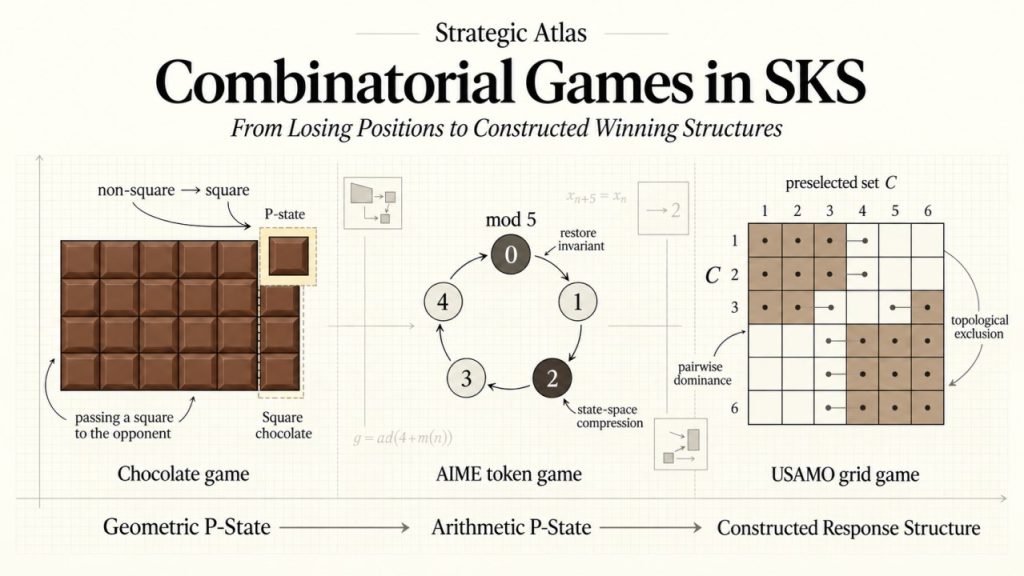
In the first game, losing positions have a simple geometric form.
In the second, losing positions are no longer geometrically visible. They emerge only after the state-space is projected modulo 5.
In the third, even that model is insufficient. Bob does not repeatedly return Alice to one recognizable losing position. He constructs a pairing architecture that converts local numerical control into global topological exclusion.
The progression is:
Geometric P-State → Arithmetic P-State → Constructed Response Structure
This is also a progression in strategic cognition.
- 1. Combinatorial Games as an Integrated Strategic State-Space
- 2. Winning and Losing States
- 3. Case Study 1. Dividing Chocolate: Who Owns the Square?
- 4. Surface Read: A Cutting Problem?
- 5. Structural Unlock: Squares Are P-Positions
- 6. Projection Mismatch
- 7. Alice’s Winning Strategy
- 8. A Restored Strategic Invariant
- 9. What If Alice Makes the Wrong First Move?
- 10. Initiative as Ownership of the P-State
- 11. Case Study 2. 2024 AIME I Problem 3: From Geometry to Quotient States
- 12. Surface Read: Exact Pile Size
- 13. Discovering the Losing Set
- 14. DCE: From Pattern to Verification
- 15. The Same Strategic Architecture as Chocolate
- Chocolate
- AIME
- 16. Axis Evolution: From Equality to Congruence
- 17. Bob’s Winning Starting States
- 18. The Restored Invariant Appears Again
- 19. Case Study 3. USAMO 2004 Problem 4: When the Navigator Must Build the Structure
- 20. Surface Read: State-Space Explosion
- 21. Strategic Unlock: Control a Region, Not the Exact Outcome
- Local control
- Global design
- 22. Constructing the Control Region C
- 23. Pairing the Cells
- If Alice plays inside C
- If Alice plays outside C
- 24. Local Dominance Forces Global Exclusion
- 25. Local Invariant, Global Consequence
- Local layer: numerical dominance
- Global layer: topology
- 26. The Evolution of the Three Cases
- 27. Cognitive Compression across the Three Games
- 28. Level 1 Compression: Chocolate
- 29. Level 2 Compression: AIME
- 30. Level 3 Compression: USAMO
- 31. The Compression Hierarchy
- 32. Stage I: The P-State Is Geometrically Visible
- 33. Stage II: The P-State Appears Only after Projection
- 34. Stage III: The Navigator Constructs the Strategic Structure
- 35. From State Control to Response-Space Control
- 36. Choosing Axes for Different Types of Combinatorial Games
- 37. DCE: A Pattern Is Not Yet a Winning Strategy
- Case 1
- Case 2
- Case 3
- 38. Strategic Initiative across the Three Cases
- Chocolate
- AIME
- USAMO
- 39. Reasoning Physics: Why Game Trees Create Heat
- 40. USC Reading
- [geo] Strategic Geometry
- [mech] Strategic Mechanics
- [thermo] Strategic Thermodynamics
- [field] Strategic Field Theory
- [topo] Strategic Topology
- [info] Strategic Information Theory
- [stoch] Strategic Stochastic Theory
- 41. Strategic Hallucinations in Game Problems
- More choices imply more strategic freedom
- Exact numerical magnitude must matter
- More detailed representation is always better
- Exact outcome control is necessary
- 42. Transfer Principle
- 43. Mathematics Navigator Protocol for Combinatorial Games
- Step 1 — Define the terminal state precisely
- Step 2 — Define the full game state
- Step 3 — Question the visible coordinates
- Step 4 — Search for P/N classes
- Step 5 — Search for a lower-dimensional projection
- Step 6 — Search for invariant restoration
- Step 7 — Test initiative
- Step 8 — If simple P/N classification is insufficient, search for pairing
- Step 9 — Search for topology
- Step 10 — Reduce the required amount of control
- Step 11 — Run DCE verification
- Step 12 — Measure cognitive compression
- Step 13 — State the final policy as a response protocol
- 44. FAQ
- Are squares special because of geometry?
- Why does Alice lose the initiative after one wrong chocolate move?
- Are the chocolate and AIME games fundamentally the same?
- Why is Case 3 a genuine next level?
- Is pairing itself the Strategic Invariant in Case 3?
- Why does Bob not need to control the exact black cells?
- What does ΔI measure?
- Conclusion
1. Combinatorial Games as an Integrated Strategic State-Space
A deterministic two-player game defines an objective mathematical state-space:
𝒮G
A game state contains enough information to determine the legal future of the game:
- the current configuration;
- the player to move;
- the legal transitions;
- the terminal condition;
- the winning condition.
But the Navigator does not operate directly on the entire state-space.
The Navigator sees a projection:
ΠN(𝒮G)
At first this projection tends to preserve what is visually or procedurally salient.
In a chocolate game, the Navigator sees dimensions and possible cuts.
In a token game, the Navigator sees the exact number of remaining tokens.
On a 6 × 6 board, the Navigator sees cells, rational numbers, row maxima, and a rapidly growing set of local decisions.
Yet these may not be the dimensions that determine victory.
The relevant SKS object is therefore the coupled system:
*𝒮 = 𝒮G × 𝒮N**
where 𝒮N represents the current cognitive state of the Navigator.
A Strategic Unlock may occur while the objective game position remains unchanged:
Gt+1 = Gt
but the Navigator changes projection:
ΠN,t+1(𝒮G) ≠ ΠN,t(𝒮G)
The board has not changed.
The Navigator has.
2. Winning and Losing States
For finite impartial games under normal play, a standard abstraction from combinatorial game theory is the distinction between P-positions and N-positions.
A P-position (Previous-player position) is a position from which the player who just moved can force a win; equivalently, the player whose turn it is loses under optimal play.
An N-position (Next-player position) is a position from which the player whose turn it is can force a win.
Their recursive structure is:
P → N
because every legal move from a P-position must give the opponent an N-position.
Conversely:
N → P
must be possible through at least one legal move.
This changes the meaning of winning strategy.
A winning strategy is not necessarily:
Find the strongest local move.
It may instead be:
Give the opponent a P-position after every one of your moves.
The difficult part is discovering what the P-positions actually are.
The first two case studies share exactly this architecture, but the representation of the P-set becomes progressively more abstract.
In SKS terms, P/N classification is a state-space compression: many superficially different game states may collapse into only two strategic classes according to who controls the Resolution trajectory.
3. Case Study 1. Dividing Chocolate: Who Owns the Square?
Alice and Bob play with a rectangular chocolate bar divided into unit squares.
Alice moves first.
The player whose turn it is holds the current rectangular piece. The player must cut it along one grid line into two rectangles and give one of the resulting pieces to the other player.
That transmitted piece becomes the position from which the other player must continue.
If a player receives a piece that cannot be divided further, that player has no legal move and loses.
Thus a 1 × 1 square is terminal.
The strategic problem is:
- find Alice’s winning strategy;
- determine what happens if Alice makes the wrong first move.
4. Surface Read: A Cutting Problem?
Suppose the current chocolate piece has dimensions:
m × n
The visible formulation suggests geometric optimization.
The Navigator may ask:
- Where should the cut be made?
- Should the pieces be balanced?
- Should the opponent receive a thin strip?
- Should area be minimized?
- Should one preserve a large piece?
- Is the aspect ratio important?
This creates a rich visible state-space:
Width × Height × Cut Position × Transmitted Piece
But most of that information is strategically unnecessary.
The decisive relation is much simpler.
5. Structural Unlock: Squares Are P-Positions
Consider a square:
k × k
Any legal straight cut divides one side into two positive parts.
Therefore every piece that can be transferred to the opponent has dimensions either:
a × k
or:
k × a
with:
1 ≤ a < k
Neither resulting piece is square.
Therefore every legal move from a square satisfies:
Square → Non-square
Now consider any non-square rectangle:
m × n, with m ≠ n
Assume without loss of generality that:
m > n
Cut the longer side at distance n.
One of the resulting pieces is:
n × n
The player can give that square to the opponent.
Therefore:
Non-square → Square
is always available.
We have obtained exactly the P/N transition structure:
Square → Non-square for every legal move,
while:
Non-square → Square
is possible through at least one move.
Since 1 × 1 is square and is terminal for the player to move, induction gives:
P = {all square chocolate pieces}
Every non-square rectangle is an N-position.
6. Projection Mismatch
The initial representation was metric:
(m, n)
It distinguishes:
2 × 7,
4 × 9,
5 × 6,
8 × 13
as very different states.
Strategically, they belong to the same class.
The useful representation is relational:
m = n ?
The entire family of rectangles collapses into only two strategic regimes:
S = square
R = non-square
The transition structure becomes:
S → R
under every move,
while:
R → S
is available to the player who recognizes the winning structure.
The Hidden Axis is therefore not size.
It is equality of dimensions.
7. Alice’s Winning Strategy
Assume the initial chocolate bar is non-square:
m × n, with m > n
Alice cuts off an:
n × n
square and gives that square to Bob.
Bob now receives a P-position.
Whatever Bob does, he must give Alice a non-square rectangle.
Suppose Alice receives:
a × b, with a ≠ b
She again cuts the longer side so that one resulting piece is square and gives that square to Bob.
Her complete strategy is therefore:
Always give Bob a square.
The size of the square need not stay constant.
Indeed, after Bob cuts a k × k square, Alice receives a rectangle such as:
a × k, with a < k
and can return:
a × a
Hence the square side lengths received by Bob form a strictly decreasing sequence:
k₀ > k₁ > k₂ > … ≥ 1
Eventually Alice gives Bob:
1 × 1
Bob has no legal move.
Alice wins.
8. A Restored Strategic Invariant
The Strategic Invariant requires a subtle interpretation.
The position does not remain square continuously.
Bob necessarily destroys the square relation when he moves.
The invariant belongs to Alice’s response protocol:
After every Alice move, Bob receives a square.
The dynamic is:
SI → opponent disturbance → SI restoration
or:
Bob receives square → Bob must produce non-square → Alice restores square
This is a restored invariant rather than a permanently conserved one.
That distinction will become central across all three cases.
9. What If Alice Makes the Wrong First Move?
Suppose Alice begins from a non-square rectangle but does not give Bob a square.
Instead she gives Bob another non-square rectangle:
a × b, with a ≠ b
Alice has done more than make a locally inefficient move.
She has transferred the strategic initiative.
Bob now occupies an N-position.
He can cut the rectangle so that Alice receives a square.
From that moment, Bob uses exactly the strategy Alice should have controlled:
Always give Alice a square.
Now the strategic cycle is:
Alice receives Square → Alice produces Non-square → Bob restores Square
Eventually Bob gives Alice:
1 × 1
Alice has no legal move and loses.
10. Initiative as Ownership of the P-State
This gives a precise interpretation of initiative.
Initiative is not merely:
Whose turn is it?
Nor is it:
Who made the most aggressive move?
Strategic initiative belongs to the player who controls the transition:
N → P
and can repeatedly hand the P-position to the opponent.
Initially Alice possesses this possibility.
If she plays:
N → P
she retains control.
If she mistakenly plays:
N → N
Bob captures the structure:
N → P
and the initiative changes hands immediately.
Thus:
Initiative = control over restoration of the losing-state invariant.
This concept becomes more abstract in the second case.
11. Case Study 2. 2024 AIME I Problem 3: From Geometry to Quotient States
Alice and Bob play with a stack of n tokens.
Alice moves first.
On each turn, a player removes either:
1 token
or:
4 tokens
The player who removes the final token wins.
The problem asks for the number of positive integers:
n ≤ 2024
for which Bob can guarantee victory regardless of Alice’s play.
At first this game appears very different from the chocolate game.
Strategically, it is remarkably similar.
12. Surface Read: Exact Pile Size
The obvious coordinate is:
n = number of tokens
One can calculate small cases:
0 → losing
1 → winning
2 → losing
3 → winning
4 → winning
Then continue.
But computing all cases up to 2024 would mistake the visible state-space for the strategic state-space.
The better question is again:
Which positions are P-positions?
13. Discovering the Losing Set
The first few states suggest:
0 = P
1 = N
2 = P
3 = N
4 = N
and then the pattern begins again.
This suggests a quotient structure modulo 5.
Define the candidate losing set:
L = { n : n ≡ 0 or 2 mod 5 }
We now need to verify that this is truly the P-set.
14. DCE: From Pattern to Verification
Pattern recognition is only the abstraction half of reasoning.
The structure must survive adversarial verification.
Suppose:
n ≡ 0 mod 5
Removing 1 leaves:
4 mod 5
Removing 4 leaves:
1 mod 5
Both lie outside L.
Now suppose:
n ≡ 2 mod 5
Removing 1 leaves:
1 mod 5
Removing 4, whenever legal, leaves:
3 mod 5
Again, every legal move leaves L.
Therefore:
L → Lᶜ
under every legal move.
Conversely:
- from 1 mod 5, remove 1 and reach 0;
- from 3 mod 5, remove 1 and reach 2;
- from 4 mod 5, remove 4 and reach 0.
Thus:
Lᶜ → L
is always possible.
Therefore:
P = { n : n ≡ 0 or 2 mod 5 }
15. The Same Strategic Architecture as Chocolate
Now compare the two games.
Chocolate
P = {squares}
Every legal move from P leads to N.
From every N-position, there is a move to P.
AIME
P = {0, 2 mod 5}
Again:
P → N
under every legal move,
while:
N → P
is available.
The game mechanics differ.
The strategic mechanics do not.
The main difference is how the P-set is encoded.
Case 1:
P = geometric relation
Case 2:
P = arithmetic equivalence class
16. Axis Evolution: From Equality to Congruence
Case 1 compressed:
(m, n) → [m = n ?]
Case 2 compresses:
n → n mod 5
This is a more abstract operation.
The original state-space:
ℕ
is projected onto the quotient:
ℤ / 5ℤ
The useful axes become:
Residue Class × P/N Status
or dynamically:
State Class × Reachability of P
The Hidden Axis is no longer visually present in the physical object.
A pile of 1002 tokens does not look strategically equivalent to a pile of 2 tokens.
But under the winning projection, both belong to the same state class.
This is the first major increase in abstraction from Case 1 to Case 2.
17. Bob’s Winning Starting States
Bob wins exactly when Alice begins in a P-position:
n ≡ 0 or 2 mod 5
Among positive integers up to 2024:
- 404 are divisible by 5;
- 405 are congruent to 2 modulo 5.
Therefore:
404 + 405 = 809
The numerical answer is:
809
But strategically, the more important result is that 2024 possible starting values do not require 2024 separate analyses.
They collapse into only five strategic classes.
18. The Restored Invariant Appears Again
The same response architecture from the chocolate game reappears.
In Case 1:
Square → Non-square → Square
In Case 2:
P-residue → N-residue → P-residue
The opponent destroys the controlled state.
The Navigator restores it.
Thus the common mechanism is:
P → opponent disturbance → N → strategic restoration → P
The object being restored has changed from geometric equality to arithmetic equivalence.
The logic has not.
19. Case Study 3. USAMO 2004 Problem 4: When the Navigator Must Build the Structure
Alice and Bob play on a 6 × 6 grid.
On each turn, a player chooses a rational number not previously used and writes it into an empty square.
Alice moves first.
After all 36 squares have been filled, the greatest number in each row determines one black square.
Alice wins if the black squares contain a path from the top of the grid to the bottom.
Two consecutive squares in the path may share either an edge or a vertex.
Otherwise Bob wins.
Now the strategic architecture changes qualitatively.
There is no immediately recognizable analogue of:
square
or:
0, 2 mod 5
that Bob can repeatedly hand to Alice.
The strategic structure must be designed.
20. Surface Read: State-Space Explosion
A move appears to require two choices:
Where should I play?
and:
Which rational number should I use?
The outcome depends on:
- 36 cell locations;
- 36 distinct numerical values;
- relative ordering within each row;
- six resulting row maxima;
- topological connectivity of their cells.
A direct game-tree representation is therefore extremely expensive.
One might try to:
- predict Alice’s path;
- control globally large numbers;
- determine exact future row maxima;
- block individual cells.
All of these attempt to control more information than Bob actually needs.
21. Strategic Unlock: Control a Region, Not the Exact Outcome
Bob does not need to determine exactly which six cells will become black.
That would be an unnecessarily strong objective.
Recall that after the board is completely filled, exactly one cell in each row becomes black: the cell containing the greatest number in that row. Therefore Bob’s real task is not to predict the exact row maximum. It is enough to restrict where that maximum is allowed to occur.
The key idea is to preselect three cells in every row and then construct a strategy guaranteeing that the final black cell of that row must be one of those three cells.
Thus, for each row, Bob aims to establish:
Final black cell ∈ {three preselected cells in that row}
He does not need to know which of the three cells will eventually contain the row maximum. He only needs to exclude the other three cells from ever becoming the final maximum.
Across all six rows, the three preselected cells per row form a set C containing 18 cells.
Bob will choose these 18 cells in advance so that C has two properties:
Every final black square is forced to lie in C.
C itself contains no top-to-bottom path.
The logic is then immediate.
If Bob can guarantee that the maximum in every row lies among the three selected C-cells of that row, then all six final black squares satisfy:
Black ⊆ C
But if C itself contains no path connecting the top of the board to the bottom, then no subset of C can contain such a path either.
Therefore Alice cannot win.
The strategic problem has now been decomposed into two independent layers.
Local control
In each individual row, Bob must force the row maximum into one of three preselected cells.
Global design
The 18 preselected cells must be arranged so that, taken together, they form a region C with no top-to-bottom connection.
Thus Bob replaces the much harder objective:
Determine the exact six black cells
with the weaker but sufficient objective:
Confine every possible final black cell to a strategically designed region C.
This is the Structural Unlock:
Exact Outcome Control → Admissible Outcome Region Control
The remaining task is therefore clear:
first construct a suitable region C, and then build a move-by-move response strategy that guarantees that the final maximum of every row lies inside it.
22. Constructing the Control Region C
Choose the following 18 cells:
● ● ● · · ·
● ● ● · · ·
● ● · · · ●
· · · ● ● ●
· · · ● ● ●
· · · ● ● ●
Here ● denotes membership in C.
Each row contains exactly:
3 cells in C
and:
3 cells outside C
This is necessary for the pairing strategy.
But the essential global property is topological:
C contains no path from the top row to the bottom row.
The separation deserves explicit verification because diagonal adjacency is allowed.
In row 3, the upper-left component occupies columns 1 and 2.
In row 4, the lower component begins at column 4.
Moving between adjacent rows while sharing either an edge or a vertex allows a horizontal displacement of at most one column.
The gap:
2 → 4
is therefore too large to create contact.
The isolated C-cell at position:
(3, 6)
does connect downward to the lower-right component in row 4.
But it cannot connect upward to the upper component, whose rightmost cell in row 2 lies in column 3.
The gap:
3 → 6
again prevents both edge and vertex contact.
Thus C separates into two components:
- an upper-left component touching the top;
- a lower-right component touching the bottom.
They are disconnected.
Therefore:
C has no top-to-bottom path.
23. Pairing the Cells
Every row contains three C-cells and three non-C-cells.
Bob pairs them within that row.
Each pair therefore contains:
one C-cell + one non-C-cell
Across six rows, the board is partitioned into 18 pairs.
Bob now uses a deterministic response protocol.
Suppose Alice writes a rational number x.
If Alice plays inside C
Bob plays in the paired cell outside C and chooses an unused rational number y such that:
y < x
If Alice plays outside C
Bob plays in the paired cell inside C and chooses an unused rational number z such that:
z > x
Such a rational number always exists because only finitely many rational numbers have been used.
After every Bob move, the following relation holds:
The larger number in every completed pair lies in C.
That is Bob’s restored Strategic Invariant.
24. Local Dominance Forces Global Exclusion
At the end of the game, every row consists of three completed pairs.
Consider the largest number in any row.
It belongs to one of those three pairs.
But in that pair, the larger number lies in C.
Therefore the row maximum must lie in C.
Hence:
Black ⊆ C
Bob still does not know exactly which six cells will become black.
He does not need to.
What he controls is their admissible state-space:
every possible realization of the six row maxima is confined to the same topologically losing region C.
Since C itself contains no top-to-bottom path, no subset of C can contain such a path either.
Therefore Alice cannot win.
Thus:
Bob has a winning strategy.
25. Local Invariant, Global Consequence
The USAMO solution contains two coupled strategic layers.
Local layer: numerical dominance
Within every completed pair:
max(pair) ∈ C
Global layer: topology
The control region satisfies:
C has no top-to-bottom connection
Combining the two:
Local Pairwise Dominance
↓
Every Row Maximum Lies in C
↓
All Black Cells Lie in C
↓
No Winning Path
The useful axis pair is therefore:
Pairwise Dominance × Global Connectivity
The original coordinates:
Exact Rational Value × Exact Cell
contain much more information than the winning strategy requires.
26. The Evolution of the Three Cases
The three problems are not three unrelated tricks.
They form a progression in the architecture of strategic control.
| Strategic layer | Case 1: Chocolate | Case 2: AIME | Case 3: USAMO |
|---|---|---|---|
| Visible state | rectangle m × n | exact pile size n | 36 cells + rational values |
| False focus | exact cut | exact n | exact values and exact black cells |
| Strategic compression | square / non-square | residue mod 5 | pairs + control region C |
| Controlled structure | square P-state | modular P-set | terminal outcomes confined to C |
| Main axes | shape regime × turn | residue × P/N status | dominance × connectivity |
| Response rule | restore square | restore P-residue | restore pair dominance |
| Strategic level | recognize P-state | discover quotient P-set | construct response architecture |
The important evolution is not simply increasing problem difficulty.
It is increasing distance between:
what the game visibly contains
and:
what the Navigator actually needs to represent.
27. Cognitive Compression across the Three Games
The progression can also be described through cognitive compression.
The visible state-space contains much more information than the winning strategy requires.
The Navigator seeks a projection:
𝒮G →ΠN 𝒮strategic
that discards strategically irrelevant information while preserving everything needed to determine winning and losing behavior.
The relevant quantity is therefore not ordinary geometric dimension.
A useful SKS information measure is:
ΔI = H(𝒮G) − H(ΠN(𝒮G))
where H represents the amount of distinguishable state information under a chosen finite model.
For a finite state-space, a simple proxy is:
ΔI = log₂(|𝒮G| / |ΠN(𝒮G)|)
We can also define the compression factor:
ηcomp = |𝒮G| / |ΠN(𝒮G)|
for finite state-spaces.
A large ηcomp means that many objectively different states become strategically equivalent.
But compression is valuable only if Resolution-relevant structure survives.
Thus:
Good Strategic Compression = Information Reduction + Preservation of Winning Structure
28. Level 1 Compression: Chocolate
The visible coordinates are:
(m, n) ∈ ℕ²
The winning projection asks only:
m = n ?
Thus:
ℕ² → {Square, Non-square}
The exact values of m and n are discarded from strategic classification.
For illustration, suppose both side lengths are restricted to integers from 1 through 10.
The visible model contains:
10 × 10 = 100
dimension pairs.
The strategic projection contains only:
2
classes.
Thus:
100 → 2
This is not a statement about the cardinality of the full infinite game.
It illustrates the information reduction produced by the strategic projection.
The Navigator retains the relation:
m = n
and discards absolute size.
29. Level 2 Compression: AIME
The original starting states are:
n = 1, 2, …, 2024
The strategic projection is:
n → n mod 5
Thus:
2024 starting states → 5 residue classes
If the terminal state n = 0 is included in the internal game graph, there are 2025 numerical states, but still only five residue classes.
Conceptually, this compression is deeper than the chocolate case.
The square/non-square distinction is visually accessible.
Modulo 5 equivalence is not visible in the physical pile.
The Navigator must construct a quotient state-space:
ℕ → ℤ / 5ℤ
The Strategic Unlock therefore involves not only compression but a change in mathematical representation.
30. Level 3 Compression: USAMO
The visible game contains 36 locations and 36 distinct rational values.
The numerical state-space is effectively continuous, while their relative ordering introduces an enormous combinatorial structure.
Bob does not preserve this information.
Inside each pair he retains essentially one strategically relevant binary relation:
Is the larger member of the pair inside C?
At the global level he discards even the exact identities of the six row maxima.
He retains only:
Black ⊆ C
The compression is therefore better described as:
Exact Numerical Configuration
↓
Pairwise Relative Order
↓
Binary Local Dominance Condition
↓
One Global Topological Containment Condition
It would be misleading to describe this simply as:
ℝ³⁶ → {0,1}
because Bob’s strategic representation retains pairing structure and board topology as well.
The crucial point is that exact rational values and most of their ordering information disappear.
Only the information required to guarantee:
max(pair) ∈ C
and:
Black ⊆ C
survives.
31. The Compression Hierarchy
Across the three cases, the nature of cognitive compression evolves:
Metric State → Relational Class → Quotient Class → Constructed Constraint System
Case by case:
(m, n) → [m = n ?]
then:
n → n mod 5
then:
full board configuration → pairwise dominance + topological containment
The Navigator becomes strategically stronger not by representing more of the game, but by learning:
which information can safely be forgotten.
This is a central SKS principle.
32. Stage I: The P-State Is Geometrically Visible
In the chocolate game:
P = {m × m}
The P-set is determined by a simple geometric relation:
m = n
The strategic lesson is:
Do not optimize individual moves before identifying the state you want the opponent to receive.
Alice’s first-move error is precisely the failure to transfer the P-state.
The consequence is immediate transfer of initiative.
33. Stage II: The P-State Appears Only after Projection
The AIME game preserves the same P/N mechanics, but the P-set is hidden more deeply.
The Navigator must first observe small cases and then replace:
n
with:
n mod 5
The winning structure becomes visible only after quotienting the state-space.
Thus the reasoning architecture evolves:
P-State Recognition → State-Space Quotient
The Navigator is no longer recognizing a visible relation.
The Navigator is constructing the coordinates in which the relation becomes visible.
34. Stage III: The Navigator Constructs the Strategic Structure
In the USAMO problem, classifying every possible board position into P and N states would be mathematically possible in principle but strategically useless.
Bob instead constructs:
- a control region C;
- a pairing map between C and its complement;
- a numerical response rule;
- a global topological exclusion.
The strategic structure is therefore engineered, not merely discovered.
The progression is:
Find a Losing State
↓
Find a Losing State Class
↓
Build a Structure that Makes the Opponent’s Winning States Unreachable
This is the deepest transition across the three cases.
35. From State Control to Response-Space Control
Cases 1 and 2 can be expressed as:
N → P
The controlling player chooses a move that gives the opponent a losing state.
Case 3 requires a broader concept.
Bob cannot determine the exact final black configuration.
Instead he guarantees that the set of possible terminal states satisfies:
𝒯possible ⊆ 𝒯Bob-safe
because every terminal configuration obeys:
Black ⊆ C
The controlled object is therefore no longer one state.
It is an entire set of possible states.
This suggests a general definition:
A winning strategy does not need to determine the trajectory. It needs to constrain the trajectory space enough to determine the outcome.
36. Choosing Axes for Different Types of Combinatorial Games
The correct axes depend on the structure that governs Resolution.
| Game architecture | Weak projection | Useful SKS axes | Typical unlock |
|---|---|---|---|
| Geometric P/N game | independent dimensions | structural relation × player | equality, symmetry, shape class |
| Subtraction game | exact pile size | quotient state × P/N status | periodicity, modular structure |
| Pairing game | opponent move × individual reply | pair status × preserved relation | predetermined response |
| Symmetry game | exact location | symmetry orbit × move ownership | mirror response |
| Invariant game | local move details | invariant × reachability | conservation |
| Monovariant game | configuration appearance | potential × terminal boundary | monotonicity |
| Topological game | local cells | local control × global connectivity | barrier or safe region |
| Decomposable game | full position | component state × aggregate value | independent subgames |
Axes should never be chosen simply because they sound compatible with SKS terminology.
They should preserve the information that determines strategic status.
The general relation is:
Active SI → Axis Selection → Resolution Projection
37. DCE: A Pattern Is Not Yet a Winning Strategy
Combinatorial games provide an unusually clean demonstration of Dual Cognitive Encoding.
The abstraction direction is:
Many Game States → Pattern → Candidate SI → Compressed State-Space
But an elegant pattern is not enough.
The verification direction asks:
Does the strategy survive every legal opponent response?
Case 1
One must prove:
Square → Non-square
for every legal move,
and:
Non-square → Square
for at least one move.
Case 2
One must prove:
P-residue → N-residue
under every legal move,
and:
N-residue → P-residue
is always available.
Case 3
One must prove all of the following:
- Alice’s paired cell is always still empty;
- Bob can always choose an unused rational above or below Alice’s value;
- the larger value of every completed pair lies in C;
- every row maximum therefore lies in C;
- C has no top-to-bottom path even with diagonal adjacency.
Thus the DCE loop becomes:
Strategic Abstraction ↔ Universal Adversarial Verification
As strategic structure becomes more complex, the verification layer grows with it.
38. Strategic Initiative across the Three Cases
Initiative also evolves.
Chocolate
Initiative means:
I can give my opponent a square.
Alice possesses this initiative initially.
If she wastes it, Bob captures it.
AIME
Initiative becomes:
I can return the opponent to the P-residue set.
The exact response changes with the residue class, but the strategic ownership remains the same.
USAMO
Initiative becomes:
I possess a response protocol that works after every opponent move.
Bob does not restore one particular board position.
He restores a structural condition:
max(pair) ∈ C
Thus initiative evolves as:
Position Ownership → State-Class Ownership → Response-Architecture Ownership
39. Reasoning Physics: Why Game Trees Create Heat
Suppose a game has approximately b legal moves at each state and depth d.
A naive game-tree analysis may expose roughly:
bᵈ
possible trajectories.
But the three cases show that most of those trajectories may be strategically redundant.
Chocolate collapses infinitely many dimensions pairs into:
{Square, Non-square}
AIME collapses more than two thousand relevant numerical positions into:
5 residue classes
USAMO discards almost all exact rational values and preserves only:
pairwise order + region membership + topology
Brute-force analysis can therefore produce:
W ≫ ΔEk
where W represents reasoning work and ΔEk represents useful progress toward Resolution.
The difference becomes Reasoning Heat.
Cognitive compression reduces that heat.
In information terms, this is the role of ΔI:
a strong strategic projection removes irrelevant information while preserving exactly those distinctions required for victory.
Strategic efficiency therefore comes not from maximal representation, but from:
minimal sufficient representation.
Or:
Good Strategic Compression = Maximum Safe Information Reduction + Preserved Resolution Structure
40. USC Reading
[geo] Strategic Geometry
All three cases are solved through changes of coordinates.
Chocolate:
(m, n) → [m = n ?]
AIME:
n → n mod 5
USAMO:
36 independently valued cells → paired cells + control region C
The geometry of the strategic representation matters more than the visual complexity of the game.
[mech] Strategic Mechanics
The decisive object is the transition law.
Chocolate:
S → R
and strategically:
R → S
AIME:
P → N
and:
N → P
USAMO:
Alice Action → Bob Paired Response → Invariant Restoration
Winning strategy is therefore a mechanism for controlling transitions.
[thermo] Strategic Thermodynamics
Tracking every possible cut, analyzing each pile size separately, or following the complete ordering of 36 rational numbers generates high reasoning work with low structural gain.
State-space compression lowers friction.
Conceptually:
μ ↓ → η ↑
A strong strategic representation produces more Resolution Gain per unit of cognitive work.
[field] Strategic Field Theory
Each problem creates its own Suggestive Field.
Chocolate attracts attention to geometry and cut placement.
AIME attracts attention to exact pile size.
USAMO attracts attention to individual values and local cells.
The visible field emphasizes action.
The winning strategy emphasizes equivalence.
[topo] Strategic Topology
Every combinatorial game has an implicit topology through state reachability.
Case 3 adds a second explicit topological layer.
Bob’s numerical strategy works only because all possible black cells are confined to a region satisfying:
C has no top-bottom connection
Thus local ordering constraints become global reachability constraints.
[info] Strategic Information Theory
Each solution discards information.
Chocolate:
(m, n) → [m = n ?]
AIME:
n → n mod 5
USAMO:
exact rational values → relative order inside pairs
These transformations form a compression hierarchy.
The important SKS quantity is not how much mathematical information survives.
It is whether the surviving information is sufficient to preserve the winning/losing distinction.
This is the strategic meaning of:
ΔI
A good projection forgets aggressively but safely.
[stoch] Strategic Stochastic Theory
None of the three games contains object-level randomness.
The uncertainty belongs to the Navigator:
What will the opponent do?
A winning strategy eliminates the need to predict that choice.
Instead of predicting one trajectory, the Navigator constructs a policy that survives the entire admissible response space.
Thus:
Prediction → Robust Response Control
41. Strategic Hallucinations in Game Problems
Several recurrent reasoning errors appear across these examples.
More choices imply more strategic freedom
Not necessarily.
Many moves may belong to the same strategic equivalence class.
Exact numerical magnitude must matter
Case 2 shows that 2 and 1002 can occupy the same strategic state.
More detailed representation is always better
Case 3 shows the opposite.
Bob wins precisely because he refuses to track information he does not need.
Exact outcome control is necessary
Again, no.
Bob never determines the exact six black cells.
He controls only the region in which all six must lie.
Thus:
Over-modeling can itself be a Projection Mismatch.
A representation may be mathematically complete and strategically inefficient.
42. Transfer Principle
The reusable lesson is not:
Look for squares.
Nor:
Try modulo 5.
Nor:
Use pairing.
Those are local manifestations.
The deeper principle is:
Search for a structure that converts many possible opponent actions into the same strategic outcome.
Sometimes that structure is a P-position:
Square
Sometimes it is a quotient class:
0 or 2 mod 5
Sometimes it is a constructed response system:
Pairing + Control Region
The level of abstraction changes.
The objective remains the same:
reduce the opponent’s apparent freedom to strategic equivalence.
43. Mathematics Navigator Protocol for Combinatorial Games
When facing a new olympiad game, the Navigator can use the following protocol.
Step 1 — Define the terminal state precisely
What exactly causes a player to win or lose?
Do not automatically assume normal-play rules.
Step 2 — Define the full game state
What information is sufficient to determine all legal future transitions?
Step 3 — Question the visible coordinates
Does the exact size, location, value, or shape really determine strategic status?
Step 4 — Search for P/N classes
Can positions be divided into losing and winning states?
Step 5 — Search for a lower-dimensional projection
Test:
- equality;
- parity;
- modulo classes;
- symmetry;
- coloring;
- component structure;
- relative order.
Step 6 — Search for invariant restoration
Ask:
What property should become true again after every one of my moves?
Step 7 — Test initiative
If a player fails to restore the strategic invariant, can the opponent capture it?
Step 8 — If simple P/N classification is insufficient, search for pairing
Can every opponent action be assigned a predetermined response?
Step 9 — Search for topology
Can one control a region rather than individual outcomes?
Step 10 — Reduce the required amount of control
Do you really need one exact final state?
Or is it sufficient to guarantee:
Outcome ∈ Safe Region
Step 11 — Run DCE verification
Prove that the strategy survives every legal opponent move.
Step 12 — Measure cognitive compression
What information has the winning projection discarded?
What minimal information remains sufficient?
Step 13 — State the final policy as a response protocol
A strong winning strategy should often reduce to one of two forms:
Always return the opponent to P.
or:
For every opponent action X, respond with F(X) so that SI is restored.
44. FAQ
Are squares special because of geometry?
Only partly.
Their strategic importance comes from the transition structure:
Square → Non-square
for every move,
while:
Non-square → Square
is always possible.
Another class of states with the same transition property could play the same strategic role.
Why does Alice lose the initiative after one wrong chocolate move?
Because she begins in an N-position with access to P.
If she instead gives Bob another N-position, Bob inherits access to P.
Once Bob gives Alice a square, he can restore the square condition after every Alice response.
The mistake therefore transfers control of the invariant.
Are the chocolate and AIME games fundamentally the same?
At the strategic level, yes.
Both contain a P-set satisfying:
P → N
under every legal move, while:
N → P
is possible.
Their difference lies in representation.
Chocolate uses a geometric relation.
AIME uses a modular quotient.
Why is Case 3 a genuine next level?
Because Bob does not simply identify a natural P-set and return Alice to it.
He constructs:
- a control region;
- a pairing;
- an order relation;
- a response rule.
Together these structures make Alice’s winning terminal states unreachable.
Is pairing itself the Strategic Invariant in Case 3?
No.
Pairing is the response mechanism.
The restored invariant is:
The larger member of every completed pair lies in C.
Pairing makes restoration of this condition possible after every Alice move.
Why does Bob not need to control the exact black cells?
Because Alice’s winning condition is topological.
Once Bob proves:
Black ⊆ C
and:
C has no top-bottom path
the identity of the individual black cells no longer matters.
This is a powerful example of controlling less information while obtaining a stronger strategic guarantee.
What does ΔI measure?
ΔI represents the amount of state information discarded by the strategic projection.
For finite models:
ΔI = log₂(|𝒮G| / |ΠN(𝒮G)|)
can be used as a simple information-compression proxy.
It is not a universal physical quantity.
Its role is to express a central SKS idea:
strong reasoning often succeeds by preserving less information, not more.
Conclusion
Combinatorial games often appear to be problems of forecasting.
They are better understood as problems of state-space control.
In the chocolate game, Alice wins by discovering that every square is a losing state for the player who receives it. Her strategy is to restore that geometric P-state after every Bob move. If she fails to do so on the first move, Bob captures the same mechanism and the strategic initiative reverses immediately.
In the AIME game, the same architecture survives, but the P-state is no longer geometrically visible. The Navigator compresses more than two thousand numerical states into five residue classes and discovers the losing set:
n ≡ 0 or 2 mod 5
The strategy remains invariant restoration, but the invariant has become abstract.
In the USAMO problem, the Navigator moves one level higher again. Bob does not repeatedly return Alice to a naturally occurring P-state. He constructs a control region, pairs the board, and uses local numerical dominance to constrain the entire set of possible terminal configurations.
The evolution is therefore:
Recognize a Losing State
↓
Recognize a Losing State Class
↓
Construct a Response Structure that Makes Winning States Unreachable
At the same time, the cognitive representation becomes increasingly compressed:
Metric State → Relational Class → Quotient Class → Constructed Constraint System
And the form of initiative evolves:
Position Ownership → State-Class Ownership → Response-Architecture Ownership
This leads to the central SKS principle of combinatorial games:
A winning strategy does not require predicting what the opponent will do. It requires constructing a state-space in which the opponent’s different choices become strategically equivalent.
The strongest Navigator therefore does not necessarily calculate farther.
The strongest Navigator discovers what can be forgotten.